
Condos in The Preserve Oakville: What Buyers Should Know in 2027
November 25, 2026
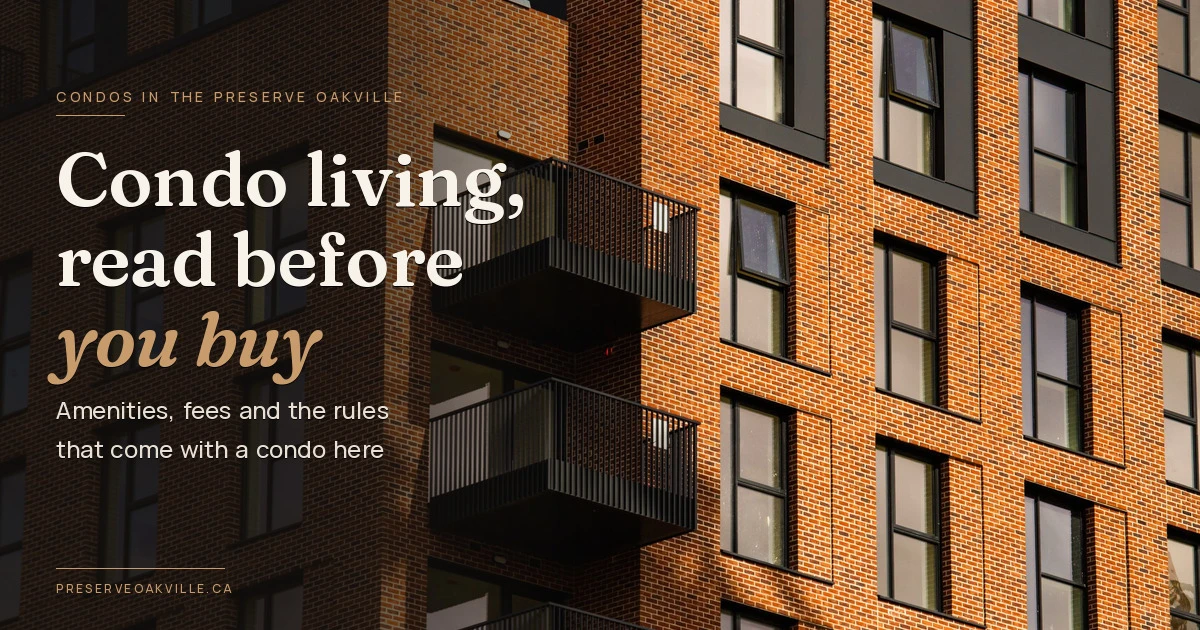
A couple selling a family house in Oakville often wants to stay near the same parks and the same grocery run, just without the lawn, the roof and the snow. A first-time buyer may want a foothold in a neighbourhood they could not otherwise afford. Both end up asking the same thing about condos in The Preserve Oakville: what kind of buildings are there, what do the amenities and fees actually cover, and what is daily life like in a small condo surrounded by freehold streets?
The Preserve was planned mostly as a low-rise community of detached houses, semis and townhomes, so its condo stock is small and specific. That makes the details of each building, its declaration, its reserve fund and its rules more important than any general statement about “Oakville condos.”
Why a Preserve Condo Is a Different Kind of Purchase
The Preserve is Mattamy’s flagship community in North Oakville, and it opened for sale in 2014. When Mattamy broke ground on The Residences of Creekshore Common in April 2016, it said all of its Oakville homes to that point had been low-rise and that this building was its first mid-rise in the town. In other words, condo living here began as an addition to a neighbourhood of freehold streets, not as its core.
That history shapes what a buyer should expect:
Fewer owners share the building. A small corporation spreads the cost of a roof, elevator, garage and amenity room across relatively few suites.
The documents carry more weight than the brochure. Launch material describes plans. The declaration, rules, budget and status certificate describe what is true today.
The setting is part of the appeal. Ponds and natural areas sit beside the buildings, while the corporation looks after the exterior.
The Short Version
Where it is: Town of Oakville planning documents place The Preserve lands north of Dundas Street, south of Burnhamthorpe Road and west of Sixth Line, and Mattamy described The Residences of Creekshore Common as an extension of the community.
Building types: the condo buildings are low-rise, four and five storeys, not towers.
What the fee pays for: the Condominium Authority of Ontario (CAO) explains that condo fees fund the common elements, reserve fund contributions and services, and that each owner’s share is a percentage set in the declaration.
Amenities cost owners whether or not they use them, according to the CAO’s guidance for resale buyers.
Status certificate: it costs no more than $100 including taxes and must be provided within 10 days, according to the CAO.
Warranty: new condo units carry Tarion’s one-, two- and seven-year coverage, and Tarion’s published maximum statutory coverage for a condominium unit is $300,000.
Reserve fund: a corporation must complete a comprehensive reserve fund study within the first year after registration, then updates at least every three years.
What Condos in The Preserve Oakville Look Like
The condo buildings near The Preserve are few in number, so it helps to look at each one on its own terms.
A Small, Low-Rise Condo Stock
The condo buildings covered here are four and five storeys. That scale matters. Fewer suites share the costs of a roof, an elevator, a parking garage and an amenity room, so each owner’s share of a major repair can be larger than in a big tower. It also tends to mean a quieter lobby, fewer neighbours on each floor and a building that looks like part of the street rather than above it.
The Residences of Creekshore Common
Mattamy’s April 2016 release is the clearest official record for this building. It described a boutique condominium on the north side of Dundas Street, west of Sixth Line, situated between two large ponds and directly next to a naturalized channel, with relationships to Munn’s Creek and Oakville’s Natural Heritage System. At launch, Mattamy listed:
layouts from 925 to 1,188 square feet, with prices starting at $405,990
floor-to-ceiling windows, 9-foot ceilings and 14-foot penthouse ceilings
large balconies, patios and terraces
a fitness centre and pet spa
a common lounge for personal events or gatherings
a rooftop terrace with barbecues for all residents
Mattamy anticipated occupancy in the summer of 2017. Third-party building profiles list the building at 1388 Dundas Street West as four storeys with 62 suites, although the civic addresses on listings use Creekshore Common. A launch brochure that promised a pet spa does not settle today’s pet policy. The registered declaration and the current rules do.
Views on the Preserve and Carding Mill Trail
Later low-rise condo buildings stand at 3265 and 3285 Carding Mill Trail, marketed as Views on the Preserve and built by Mattamy. Listing records describe a five-storey boutique building with underground parking, a party room and a rooftop deck, with some suites overlooking a nearby pond, and list the year built as 2023. Marketing and listing sources are not the registered documents, so confirm the amenities, suite count and rules for the building through the condominium plan, the declaration and the status certificate.
The Town of Oakville’s Ward 7 development application listings also show a draft plan of condominium for 3250 Carding Mill Trail by Mattamy (Carding Mill) Limited. It describes a mixed-use, five-storey condominium building with 157 units and about 1,077 square metres of commercial space. Check that application’s current status with the Town before assuming a date or a finished building.
If a building uses a shared heating and cooling system, such as geothermal, ask the corporation how the system is owned, serviced and billed, and whether any related charge sits outside the basic condo fee.
Other Buildings Along Dundas Street
Several other mid-rise condos stand along the Dundas Street corridor near The Preserve. Some are in the community and some are not, and listing remarks use “Preserve,” “North Oakville” and “Glenorchy” loosely. The civic address, the condominium corporation number on the status certificate and the legal description tell you which building and which corporation you are actually buying into.
Building Amenities: Promised, Built and Governed
An amenity appears in three places over a building’s life: in the launch material, in the finished building, and in the rules that govern its use. They do not always match.
What the Launch Material Said
The 2016 Creekshore Common release is a good example of launch language: fitness centre, pet spa, common lounge for private events and a rooftop terrace for all residents. Lists like this describe intentions at a point in time. They are not a guarantee that a room is open, staffed or available every day.
What the Rules Control
The CAO’s guidance for resale buyers explains that owners must follow the declaration, by-laws and rules, and that rules often cover the use of amenities. Booking rules, guest limits, hours, rooftop barbecue use and pet restrictions are all typical examples. Read the rules alongside the amenity list. A rooftop terrace that is closed in winter or a party room that needs a deposit is still an amenity, but it may not fit the way you plan to use it.
What Amenities Cost Owners
The same CAO guidance makes a point many buyers miss: owners pay for the common elements whether or not they use them. In a small building, a gym, a lounge and a rooftop terrace are shared among relatively few suites. Their upkeep, insurance and eventual replacement show up in the operating budget and in the reserve fund plan.
Amenity question | Where to find the answer | Why it matters in a small building |
|---|---|---|
Which amenity rooms are part of the common elements? | Declaration and condominium plan | Shared costs fall on fewer owners |
Who can use them, and when? | Rules and any amenity booking policy | Limits can change how useful a feature is |
Is a major amenity repair planned? | Reserve fund study and status certificate | A rooftop or garage repair can be large |
Are pets permitted, and on what terms? | Declaration and rules | Launch material and listings can disagree |
How is any shared heating or cooling system billed? | Budget, declaration and any service agreement | Some charges sit outside the basic fee |
Maintenance: What the Fee Pays For
The monthly fee is the number buyers see first, but what sits behind it matters more than the amount.
How the Fee Is Calculated
Under the CAO’s explanation of common expenses, a condo fee covers maintenance of the common elements, contributions to the reserve fund and services such as cleaning, building maintenance and management. Each unit’s share is a percentage in the declaration and can vary with unit size. The annual budget multiplied by that percentage gives the owner’s contribution. A larger suite generally pays more, even if its owner never uses the gym.
Special Assessments and Chargebacks
If a corporation’s budget falls short, the CAO notes that it may levy a one-time special assessment on every unit. The CAO also explains that a corporation may add certain costs to an owner’s common expenses in accordance with its declaration, which is known as a chargeback. Both belong on your list of questions, because neither appears in the monthly fee you see on a listing.
The Reserve Fund in a Young Building
The CAO explains that a corporation must complete a comprehensive Class 1 reserve fund study within the first year after its declaration and description are registered. After that, Class 2 and Class 3 updates alternate at least every three years. The board must review each study within 120 days and propose a plan for future funding, and owners must receive a notice of that plan within 15 days of its being proposed. Each study includes a funding plan projected over at least 30 years.
For a building completed in the last few years, the first study sets the tone. The CAO notes that contributions in the first funding plan are usually higher than those made before the first study, so a young building’s fee can rise as the plan takes effect. Ask for the most recent study, the funding plan, and whether contributions are scheduled to increase.
What Listing Fees Do and Do Not Show
Advertised maintenance fees on listings are useful for a first look, but they are not the corporation’s fee schedule. They are figures for a particular suite at a particular time. The status certificate gives the fee for the unit you are buying and the budget, reserve fund and special assessment information that goes with it.
Inside the Suite Versus the Common Elements
The declaration sets out which repairs belong to the owner and which belong to the corporation. In general, the corporation looks after the common elements, and the owner looks after the unit as the declaration describes. Owners still carry their own unit insurance for contents, improvements and liability. How a condo owner’s policy fits alongside the corporation’s policy is one of the questions worth settling before closing, and it comes up often with home insurance in The Preserve Oakville.
Lifestyle: A Small Building in a Freehold Neighbourhood
Daily life in a Preserve condo is shaped as much by the surrounding streets, parks and roads as by the building itself.
Green Space Without the Yard Work
The setting is the main draw. Mattamy’s 2016 release described Creekshore Common as sitting between ponds, beside a naturalized channel and close to Munn’s Creek, designed to be walkable, cycle-friendly and transit-oriented. Many Preserve condo owners live within a short walk of the same parks, trails and ponds that the surrounding freehold streets enjoy, without maintaining a yard. It also helps to know what those ponds are designed to do, and what they are not, when living near stormwater ponds in The Preserve Oakville.
Errands, Traffic and Transit
The Preserve is close to the retail and services along Dundas Street, but it is still a suburban location. Dundas carries heavy traffic at peak hours, and many households keep at least one car. Check the parking space and any locker in the title or the status certificate, confirm visitor parking rules, and review the routes on the Oakville Transit pages if you plan to rely on the bus.
Schools for Households with Children
Schools are assigned by address, not by building name. Confirm the designated school through each board’s school locator, such as the Halton District School Board’s Find My Local School tool, before you rely on a listing remark. Parents comparing options can start with the top schools in The Preserve Oakville, but the boards make the final call.
Condo or Townhome Inside The Preserve
Many buyers weigh a Preserve condo against a POTL or freehold townhome a few streets away. The condo moves most exterior maintenance to the corporation and adds a building’s rules. The townhome adds stairs, space and more control, with either no shared fee or a smaller POTL fee. The difference shows up in condo and POTL fees in The Preserve Oakville and in how townhomes and condos compare as an Oakville investment. Owners planning to sell a larger house first will also find the trade-offs of downsizing in The Preserve Oakville relevant.
Warranty Coverage in Newer Buildings
Some condos in The Preserve are recent enough that warranty dates still matter. Tarion explains that the warranty on a new condominium unit’s work and materials begins on the occupancy date. The one-year coverage includes items such as defects in work and materials. The two-year coverage includes water penetration and defects in the electrical, plumbing and heating systems. The seven-year coverage for major structural defects ends on the seventh anniversary of the start date.
Tarion also sets limits, and they depend on when the project’s first agreement of purchase and sale was signed. Under Tarion’s published coverage limits, the maximum statutory coverage for a condominium unit is $300,000, including for agreements signed on or after July 1, 2023, when the limit for freehold homes rose to $400,000. Maximum coverage for the common elements is $50,000 times the number of units for agreements signed before February 1, 2021, and $100,000 times the number of units after that date. Because one Tarion information sheet for new condominium units has cited a $400,000 figure, confirm the limit for your building with Tarion. The common elements warranty is separate, begins when the condominium is registered and is managed by the condominium corporation.
For a suite first occupied in 2023, for example, the one- and two-year periods have already passed by 2027, but the seven-year structural window runs until 2030. A resale buyer should ask the manager whether any common element claims are open, and the seller for the original occupancy date, because that date sets the deadlines. The claim process and timelines are covered in more detail under Tarion warranty and new home deficiencies in The Preserve.
A Working Sequence
Identify the building and corporation. Confirm the civic address, the corporation number and the legal description. Do not rely on “Preserve” in the listing title.
Request the status certificate early. Anyone can request one. Make your offer conditional on a lawyer’s review of it.
Read the declaration, by-laws and rules. Look for pet terms, rental restrictions, amenity booking rules and the owner’s repair responsibilities.
Review the budget and reserve fund study. Note the most recent study date, the funding plan and any scheduled increases.
Ask about special assessments and litigation. Litigation involving the corporation is worth checking, because owners can end up sharing the cost.
Check parking, lockers and storage. Confirm what is owned, what is exclusive use and what is assigned by the corporation.
Confirm warranty status. For a newer building, note the occupancy date and which Tarion periods remain.
Confirm the school and the commute. Use the board school finders and drive or ride the route at the time you would travel.
Walk the amenities. Visit the gym, lounge and rooftop to see what is open and how they are maintained.
Points Worth Double-Checking
Pet rules. Creekshore Common’s launch release promised a pet spa, but only the declaration and current rules decide what is permitted today.
Unit counts and building names. Third-party profiles can differ. Use the condominium plan.
Shared energy systems. If the building uses one, ask whether it is owned by the corporation or a third party, and whether any energy or service charge is billed outside the condo fee.
The reserve fund in a small building. Fewer owners share each major repair. Read the funding plan, not just the current balance.
Advertised fees. A listing fee is a snapshot for one suite. The status certificate is the document that counts.
Launch-era features. A launch brochure describes plans at the time it was printed. Confirm what was built and what the rules allow today.
Final Thoughts
A condo in The Preserve can be a way to live beside ponds, trails and established freehold streets with far less maintenance than a house. The trade-off is that a small building’s finances, rules and amenity costs are shared among relatively few owners, so the documents carry more weight than the brochure. Start with the address and the corporation, read the status certificate and the reserve fund study with your lawyer, and test the amenities and rules against how you actually live.
FAQs
Are there many condos in The Preserve Oakville?
No. The Preserve was planned mainly as a low-rise community of detached homes, semis and townhomes. Its condo stock is a small number of low-rise buildings, including The Residences of Creekshore Common, which Mattamy described in 2016 as its first mid-rise building in Oakville, and the Carding Mill Trail buildings marketed as Views on the Preserve.
What amenities do Preserve condo buildings have?
It depends on the building. Mattamy’s 2016 release promised Creekshore Common a fitness centre, pet spa, common lounge and rooftop terrace with barbecues. Listing records for the Carding Mill Trail buildings mention underground parking, a party room and a rooftop deck. Confirm what exists today and how it may be used through the declaration, rules and a site visit.
How much are condo fees in The Preserve?
There is no official community-wide figure. Each corporation sets its own budget, and each unit pays the percentage stated in the declaration. Advertised fees on listings are figures for particular suites at particular times. The status certificate shows the fee for the unit you are buying.
Are pets allowed in condos in The Preserve?
It varies by building. Creekshore Common’s 2016 launch material mentioned a pet spa, but launch material is not a rulebook. Only the registered declaration and the current rules of the specific corporation decide what is permitted, so review them before you make a firm offer.
What should I check before buying a resale Preserve condo?
Request the status certificate, which costs no more than $100 including taxes and must be provided within 10 days. Review it with your lawyer alongside the declaration, rules, budget and latest reserve fund study. Also confirm parking and locker ownership, any special assessments or litigation, the remaining Tarion warranty periods and the school designation for the address.
Tags
Recent Blogs

Multigenerational Homes in North Oakville: Buyer Essentials for 2027
November 26, 2026
Read More
Home Maintenance Checklist For 10-Year-Old Homes In The Preserve Oakville
November 20, 2026
Read More
Construction Near Homes In North Oakville: Noise, Dust And What Preserve Buyers Should Check
November 18, 2026
Read More
Subdivision Assumption in Oakville: What Preserve Homeowners Should Know in 2027
November 24, 2026
Read More