
Stormwater Ponds in The Preserve Oakville: What Buyers Should Know in 2027
November 24, 2026
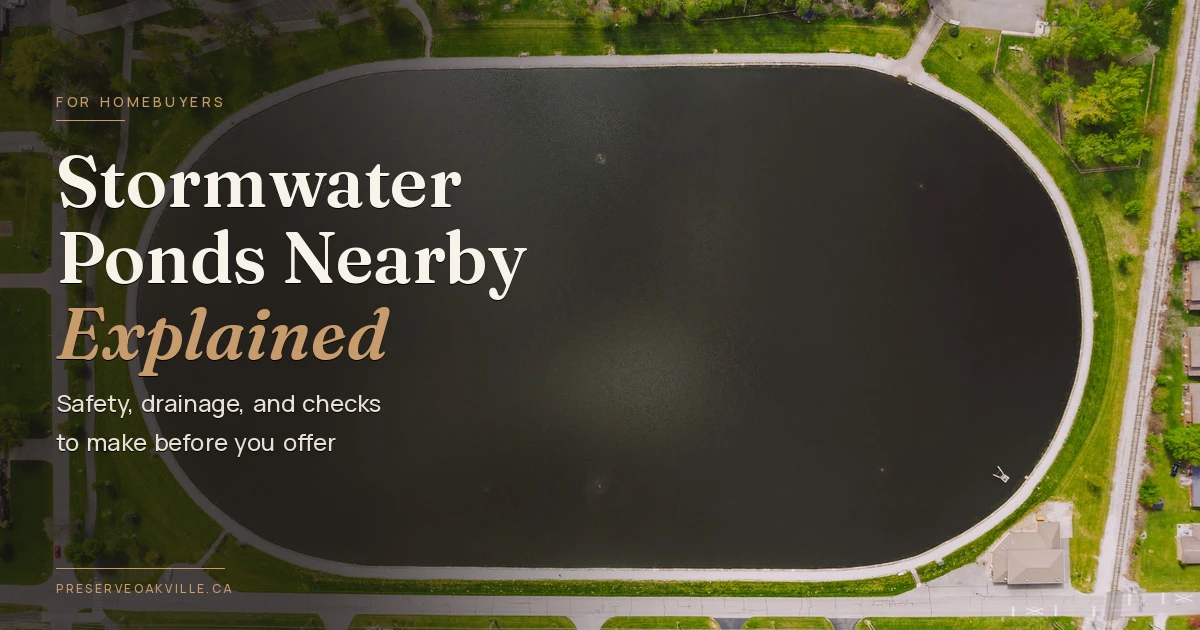
A pond at the edge of a new Oakville street can look like a park feature. Stormwater ponds in The Preserve Oakville, as in the rest of the town, are usually doing a job: holding back runoff after rain or a melt, settling out sediment, and releasing water more slowly toward creeks and Lake Ontario. The Town of Oakville calls these facilities stormwater management ponds, and it is clear about one point that homebuyers sometimes miss. They are not recreational lakes.
This briefing is for people looking at homes near stormwater ponds in The Preserve Oakville in 2027 and beyond. It gives a buyer-focused reading of what the town actually says: how the ponds work, why they sit beside houses, what is prohibited on the water, who looks after them, and how that sits beside the town-wide stormwater fee. It does not assign a particular pond to a particular lot, and it does not treat a landscaped shoreline as a private amenity.
Why Stormwater Ponds Sit Beside Homes in The Preserve Oakville
New communities replace open ground with roofs, roads and driveways, and rain that once soaked into fields now runs off in a hurry. Ponds are placed inside or at the edge of a neighbourhood because that runoff has to be slowed down and cleaned close to where it is created, before it reaches creeks and Lake Ontario. That is why a pond can end up a short walk from the back fence.
For buyers, the location tells you three useful things:
The pond is part of the approvals. Ponds are planned as part of how a development manages its runoff, not added as scenery afterward.
Responsibility can change over time. Under the town’s pond policy, ponds still awaiting assumption are covered alongside the ones the town already runs, and the town describes assumption as the step where it takes over operation and maintenance.
A pond is a working facility first. Its landscaping, paths and shoreline planting exist to support the job of storing, slowing and filtering water.
Understanding why the pond is there makes the rest of this briefing easier to apply to a specific street.
The Short Version
Stormwater ponds are engineered parts of Oakville’s drainage system, not swimming holes or skating rinks.
Town-wide pond count: the town operates and maintains 52 stormwater management ponds, with 15 more awaiting assumption. That brings the system to 67 ponds in total.
How they work: water enters through inlets, is stored and released at a controlled rate, and drops sediment before it moves on.
Safety: swimming, skating, wading, boating, fishing and sledding are prohibited, among other activities. Water levels change quickly and winter ice is unpredictable.
Cost: the stormwater fee is charged by property type, not by pond proximity. In 2027 residential properties pay 75 per cent of the full rate.
A pond beside a backyard can still be a pleasant outlook. It can also mean waterfowl, periodic maintenance, and a need to understand where the town’s responsibility ends and a homeowner’s lot drainage begins. Those are buyer issues, not only engineering issues.
How Stormwater Ponds Work in Oakville
In a developed neighbourhood, roofs, driveways, roads and parking areas do not absorb rain the way an open field does. Runoff moves quickly toward storm sewers, creeks and the lake, which raises the risk of creek erosion and flooding and can carry contaminants off hard surfaces. The town’s stormwater management ponds are built to control the quantity and quality of that runoff.
From Catch Basin to Controlled Release
Catch basins, storm sewers and overland flow routes direct water into a pond. Every pond has at least one inlet. The pond stores the water and releases it more slowly, which reduces the potential for downstream erosion and flooding. Debris and contaminants settle as sediment, and the dense planting around the pond is meant to help filter that material.
Inspection and Maintenance
The town inspects all of its ponds visually each year and separates routine work from heavier, less frequent work.
Type of work | What it includes |
|---|---|
Routine maintenance | Removing debris, controlling invasive plants, looking after structures such as gates, locks and valves, and caring for the surrounding plants |
Non-routine maintenance | Bank stabilization, structural repairs, and draining a pond to remove sediment |
Ponds do not function properly when they fill with sediment. The town says sediment removal is normally needed about every 10 to 25 years, depending on size and location.
The Long-Term Cost Picture
Sediment removal is a large line item for the town. Its Rainwater Management Plan update estimates $640 million over 30 years to care for storm sewers, culverts, creeks, shorelines, ponds, ditches and harbours, including $34.9 million to clean out sediment from the town’s 67 ponds. For a buyer, the takeaway is simple: ponds are maintained as long-term infrastructure, and that work can temporarily change how a pond looks and how close you can get to it.
A pond that looks still is still part of an operating system. Maintenance can mean equipment, temporary drawdowns and restricted access. It is not a failure of the neighbourhood. It is how the system is designed to be kept working.
Stormwater Ponds in The Preserve Oakville: What Buyers Should Know
Stormwater ponds in The Preserve Oakville sit in the same town-wide system as ponds in other neighbourhoods. This article does not invent a lot-by-lot map or a Preserve-only pond count, because the official source reviewed here is the town’s system-wide information, not a parcel register for one subdivision. What you can usefully do as a buyer is identify whether a pond is next to the property you are considering, then ask the right questions about assumption, access, fencing, grading and insurance.
Is the Pond Assumed by the Town?
The town’s figure of 15 ponds awaiting assumption is town-wide. It does not tell you the status of the pond behind one street in The Preserve. Your lawyer, the builder if the home is new, and the town can help you confirm who is responsible for the facility today. On a new build, keep that question separate from any Tarion warranty and new home deficiencies claims, which follow their own process.
Is the Edge Public Land or Part of the Lot?
Walking a landscaped berm is not the same as owning it, and planting, fencing or dock-style alterations can be restricted. If a listing photograph leans on the water as a selling feature, confirm the property line, any easements, and what the town or the conservation authority allows at the edge.
Ponds Versus Conservation Land
The Preserve also sits near conservation land and natural corridors, which is a related but separate topic. A stormwater pond is a constructed facility. A creek corridor or conservation holding is not automatically the same thing. If the lot you are considering backs onto a valley or a protected area as well as a pond, read both sets of rules, because buying beside conservation land in The Preserve comes with its own considerations.
The wider picture of daily life and ownership costs is a separate question, and it is worth weighing alongside living in The Preserve Oakville in 2027. This article stays on the ponds themselves.
Homes Near Stormwater Ponds: Safety Rules
Homes near stormwater ponds can be entirely reasonable purchases. The safety rules still apply to every household, including visitors and children who may treat the water as a play space.
The town’s prohibited list is not subtle. Recreational activities are prohibited, including, but not limited to, swimming, skating, wading, boating, fishing and sledding. The reasons given are practical. Water is constantly moving in and out, so levels can change quickly. Ice that forms in winter is unpredictable, partly because there may be salt in the water. Safety and warning signs have been placed at each pond, and the town asks adults to review those warnings with younger family members and friends.
What This Means for Buyers
A “pond view” is not a private beach, a skating rink or a place to launch a canoe.
If you are buying with children or dogs, walk the actual edge and read the posted signs rather than assuming a decorative rail is a complete barrier.
Winter photographs can make ice look inviting. The town is telling you not to trust it.
How Residents Help the Ponds Work
The town asks residents to help keep ponds working properly:
Dispose of trash properly and join litter clean-ups where possible.
Keep grass clippings and leaves out of the pond and the planting around it.
Minimize fertilizer use.
Do not disturb the plants around the ponds.
Do not drain swimming pools or dump toxic substances, such as oil or antifreeze, into the ponds or storm sewers.
Do not plant trees in a park area that contains a pond without town approval.
Report beaver or other animal activity that may affect the facility to ServiceOakville at 905-845-6601.
Obey the posted signs.
Those are resident responsibilities, not a reason to avoid a street. They are, however, part of living next to a piece of municipal infrastructure.
Stormwater Management Oakville and the Town Fee in 2027
Stormwater management in Oakville now has a dedicated fee, introduced in 2026, that appears as a separate line on the property tax bill. The town says it replaces stormwater costs that were previously folded into property taxes, and the revenue is reserved for the rainwater management program, including maintenance and repair of storm sewers and ponds.
The fee is a town-wide charge based on property type. It does not depend on whether your lot faces a pond, and it is not based on what is built or installed on the property. Residential fees are phased in over three years, so 2027 is the 75 per cent year.
Residential type | 2026 (50%) | 2027 (75%) | Full rate, 2028 (100%) |
|---|---|---|---|
Low density (detached homes) | $137 per year | about $205 per year* | $273 per year |
Medium density (semi-detached) | $64 per year | $96 per year | $128 per year |
High density (townhomes, condos, apartments) | $30 per year | about $45 per year* | $60 per year |
*2027 detached and high-density amounts are 75 per cent of the published full rate, rounded. The town’s own worked example shows $96 for a semi-detached home in 2027.
Residential properties are not eligible for the non-residential credit program expected to launch in 2027. If you believe a property has been placed in the wrong category, the town has a review process for fee assessments.
The key point for pond buyers: seeing a pond behind a street is not what triggers the bill. Owning a property in Oakville, in the applicable class, is. The fee sits on the same bill as your regular taxes, so budget the two together with the MPAC assessment and property tax in Oakville that make up the rest of that bill.
Drainage Near Homes: Who Looks After What
Drainage near homes is easy to oversimplify. The pond, the storm sewers that feed it, and the overland routes that carry overflow are municipal or subdivision infrastructure, subject to assumption and to the town’s maintenance program. The grading of a private lot, the downspouts, and any changes a homeowner makes to a swale or a rear yard are a different layer of responsibility, and some backyard work needs Oakville backyard renovation permits first.
A buyer should not assume that a damp corner of a yard is “the pond’s problem,” or that a pond next door automatically raises or lowers flood risk on a particular lot. Lot-specific drainage depends on the approved grading, the condition of local sewers and overland routes, and how the house itself was built and altered. If water in the basement is a concern, that is an insurance and inspection conversation as well as a municipal one. A pond photograph will not tell you what a policy actually pays for, so ask your broker how water, sewer backup and overland flood coverage applies to that specific home.
Before you firm up an offer, walk the lot after a rainfall if you can, ask the seller or builder how downspouts and rear-yard drainage were designed, and have your lawyer flag any easements or drainage blocks on title and on the survey.
A Working Sequence for Buyers
Identify, on foot and on a current survey or plan, whether a stormwater pond sits beside or near the property, and where the property line actually is.
Ask who currently maintains that pond: the town, after assumption, or another party if it is still awaiting assumption.
Read the posted safety signs and treat them as binding, not as decoration.
Confirm easements, fencing rules and any restrictions on planting or alterations along the edge.
Walk the lot drainage, downspouts and any low spots, preferably after rain.
Ask your insurance broker about sewer backup and overland flood coverage rather than inferring risk from the view.
Place the town’s stormwater fee in the right budget line, based on property type, not the pond.
Have your lawyer review the answers before you waive conditions.
Points Worth Double-Checking
A listing that treats the pond as a recreational feature is at odds with the town’s safety rules.
Assumption status is fact-specific. The town-wide figure of 15 ponds awaiting assumption does not identify the pond on your street.
Rear-yard landscaping can interfere with drainage even when the pond itself is well maintained.
Sediment removal and other non-routine work can temporarily change how a pond looks and how close you can get to it.
The stormwater fee is a separate line on the tax bill and is not a pond-front surcharge.
Final Thoughts
If you like a street in The Preserve that happens to sit near a pond, keep going. The town built these facilities to manage runoff, and a well-maintained pond is doing a job a buyer should want done. Use the official safety rules, confirm who is responsible for the pond and where your property line sits, and keep the fee and the pond in their proper places on your budget. Then decide on the house, not the water.
FAQs
Are stormwater ponds in The Preserve safe for swimming or skating?
No. The Town of Oakville says stormwater management ponds are not safe for recreational use and prohibits activities including swimming, skating, wading, boating, fishing and sledding. Water levels can change quickly, and ice can be unpredictable.
How many stormwater ponds does Oakville operate?
The town operates and maintains 52 stormwater management ponds, with 15 additional ponds awaiting assumption, for 67 in total. These figures are town-wide, not a count of ponds inside The Preserve alone.
Does a home beside a pond pay a higher stormwater fee in 2027?
Not because of the pond. The town sets the residential fee by property type (detached, semi-detached, or townhome and condo) and not by what is on the lot. In 2027 residential properties pay 75 per cent of the full rate. Confirm the category assigned to the specific property.
Who maintains a pond beside a street in The Preserve?
Once a pond is assumed, the town inspects and maintains it under its stormwater program. Some ponds are still awaiting assumption, so confirm the status of the specific facility rather than assuming the town already has it.
Can I fish, boat or let children play on the ice?
No. The town’s prohibited list includes fishing, boating and skating, along with swimming, wading and sledding. The posted signs apply to guests and children as well.
Will the town drain the pond for maintenance?
Sometimes. Non-routine maintenance can include draining a pond to remove sediment, normally about every 10 to 25 years depending on size and location. Expect the pond to be maintained as infrastructure, not left untouched as a decorative lake.
Tags
Recent Blogs
Home Maintenance Checklist For 10-Year-Old Homes In The Preserve Oakville
November 20, 2026
Read More
Construction Near Homes In North Oakville: Noise, Dust And What Preserve Buyers Should Check
November 18, 2026
Read More
Subdivision Assumption in Oakville: What Preserve Homeowners Should Know in 2027
November 24, 2026
Read More
Home Insurance in The Preserve Oakville: What Buyers Should Know in 2027
November 24, 2026
Read More