
Subdivision Assumption in Oakville: What Preserve Homeowners Should Know in 2027
November 24, 2026
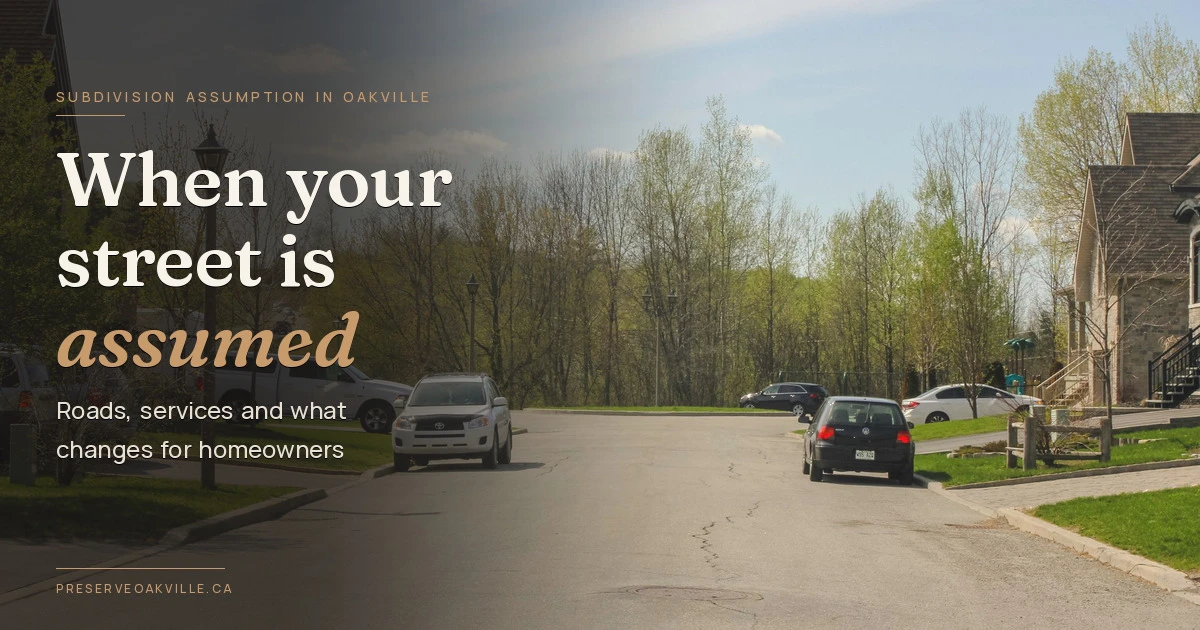
A homeowner on a newer street in The Preserve wants to widen the driveway, put up a backyard fence and add a small deck before summer. A neighbour mentions that the builder has to sign off first because “the subdivision hasn’t been assumed yet.” Another says the Town now handles everything. Both may be partly right, and the difference depends on one quiet municipal step: subdivision assumption in Oakville, the point at which the Town formally takes over the roads and public works that a developer built.
Assumption rarely makes the news, yet it decides who fixes a sunken curb, who maintains the storm sewers, who signs off on grading and whose permission a household needs before changing a lot. The Town of Oakville publishes the rules across several pages. This briefing brings them together for buyers and owners in The Preserve, using the Town’s own wording, and notes where those pages give different timelines.
Why Subdivision Assumption Matters to Homeowners in The Preserve Oakville
A street can feel finished long before it is legally finished. The roads are open, the lawns are sodded and the moving trucks have come and gone, yet the developer may still be responsible for much of what sits beneath and beside the pavement. For households in the new communities of north Oakville, that gap shapes everyday decisions.
Assumption tends to matter at three moments:
When buying. Whether the street has been assumed tells you who to call about repairs and which approvals a future project will need.
When planning exterior work. Fences, decks, pools, sheds and wider driveways can all touch grading and drainage, so the developer’s sign-off may come before the Town’s permit.
When something on the street needs fixing. A cracked curb or settling catch basin is handled differently before and after assumption.
Knowing where a street sits on that timeline turns a vague “it depends” into a short list of calls and documents.
The Short Version
What assumption is: once a plan of subdivision is registered, the land under its roads, traffic islands and parks is transferred to Town ownership. Responsibility for maintaining and replacing the infrastructure moves from the developer to the Town only after it is inspected and accepted.
Timing: the Town says assumption typically does not occur until at least five years after the first house is built, and that the first sign a subdivision is nearing eligibility is a final lift of asphalt on the streets.
Before assumption: the developer remains responsible for municipal and regional services and street maintenance, except snow clearing and garbage pickup.
Services that still arrive: snow removal, fire protection and parking enforcement come from the Town, and garbage collection and police from Halton Region, even before assumption.
Home projects: in an unassumed area, check with the developer before changes that could affect grading or drainage, such as fences, pools, sheds and decks, and before widening a driveway.
How to check: assumption is tracked by registered plan number, which looks like 20M followed by digits and appears on an MPAC assessment notice or a tax bill. Council makes it official by by-law.
Subdivision Assumption in Oakville, Explained
The Town of Oakville describes assumption as the transfer of responsibility for maintaining new subdivisions and roads from the developer to the Town. Its New Subdivisions page puts it another way: final acceptance or assumption happens when the municipality takes on responsibility for maintaining all municipal services from the developer.
Ownership and responsibility are separate ideas here. The public land under the streets becomes Town property when the plan is registered. What changes at assumption is who must look after, repair and eventually replace what was built on it. Until then, that obligation sits with the developer under its subdivision agreement. After assumption, the Town says maintenance of that infrastructure is included in its budgeting process.
Who Builds What in a New Subdivision
The Town separates the roles of developer and builder, and the split helps explain why assumption matters.
Party | Responsibilities listed by the Town |
|---|---|
Developer | Grading and drainage, sewers, watermains, roads, curbs and sidewalks, street lighting, street cleaning until assumption, street trees, and fencing next to public open space |
Builder | Constructing the house, grading and sodding the lot, and building the driveway |
Town of Oakville | Inspecting public works against Town standards, then maintaining them after assumption |
Halton Region | Water and sanitary sewer services once the subdivision is assumed, plus waste collection |
On water, the Town is specific. Halton Region is responsible for water and sanitary sewers, but not storm sewers. The developer is responsible for building and maintaining the water and wastewater services until the subdivision is assumed by the Town and the Region begins providing those services.
What the Subdivision Agreement Does
Every new subdivision rests on a subdivision or development agreement. The Town says this document sets out the developer’s obligations to the municipality or region for roads, sewers, watermains, parks, open spaces and other services, and calls these agreements complex legal documents. It urges purchasers to review them with a lawyer, especially the warning clauses and special conditions, before signing.
Purchase agreements for new homes should also include purchaser warning clauses about the subdivision. If a clause is unclear, the Town directs homeowners to its Development Engineering department at 905-845-6601, ext. 3040.
How Long Assumption Takes in Oakville
The Town’s own pages give more than one reference point, and a buyer should know all of them.
Town page | What it says about timing |
|---|---|
New Roads and Assumption of Subdivisions | Typically not until at least five years after construction of the first house; the process can take several years and involve many agencies and departments |
New Subdivisions | Usually within three to six years after the subdivision is registered, or when all the developer’s requirements are fulfilled |
New Communities of Oakville | It can take five to seven years to completely build out a subdivision |
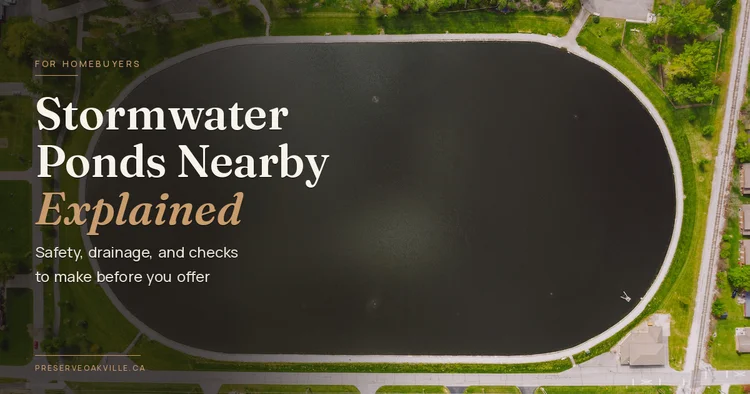
These statements measure from different starting points, registration in one case and the first house in another, so they are not strictly contradictory. Taken together, they say that several years between moving in and assumption is normal. For stormwater ponds, the Town’s New Subdivisions page notes that developers monitor and maintain them, including routine dredging, until assumption, which can be up to 10 years after construction. What happens once the Town takes over those facilities depends on how stormwater ponds in The Preserve Oakville are inspected and maintained.
What Happens Before a Subdivision Is Assumed
The Town’s New Communities of Oakville page describes what a subdivision typically has before it is assumed: sod on the properties, proper grading on driveways and lots, and entrances or swales, which are shallow drainage ditches. There will usually be no settlement of land on driveways and no encroachments on the municipal right-of-way.
The developer hires a professional consulting engineer to work with Town inspectors. Together they confirm that public infrastructure such as roads, sidewalks and open space systems was built to Town standards and that lot grading and drainage meet Town requirements. Once the inspections are complete and repairs are done, Town staff recommend assumption to Council.
The Council By-Law
Assumption becomes official through a Council decision. Recent examples show the form it takes. At its May 19, 2026 meeting, Oakville’s Planning and Development Council passed By-law 2026-072, a by-law to assume the completed public works within Registered Plan 20M-1129. Council has also passed partial assumptions: in August 2025 it partially assumed the completed works within Registered Plan 20M-1186, with certain streets excluded, and in March 2026 it assumed public infrastructure that included two stormwater management ponds under a site plan approval. None of these examples is in The Preserve. They are cited only to show how the process works.
Developer Securities
Subdivision agreements are backed by financial security. Under the Town’s development securities procedure, the director responsible for the secured works can authorize a reduction or release of security once obligations are met to the Town’s satisfaction, as shown by inspection and certification. The same director can authorize a draw on the security where obligations have not been met. For a homeowner, the point is simple: the Town holds leverage until the works are accepted, which is one reason assumption is not rushed.
Living on an Unassumed Street in The Preserve
An unassumed street is not a private road. The Town says unassumed roads are open to the public and subject to the ordinary rules of the road under the Highway Traffic Act, including parking regulations. Services residents notice most still arrive.
Service before assumption | Provided by |
|---|---|
Snow removal | Town of Oakville |
Fire protection | Town of Oakville |
Parking enforcement | Town of Oakville |
Police and Highway Traffic Act enforcement | Halton Region |
Garbage collection | Halton Region |
Street cleaning, road and sewer maintenance | Developer, until assumption |
What residents may notice is the developer’s role in day-to-day repairs. A cracked curb, a settling catch basin or a missing top layer of asphalt on a newer street is usually the developer’s to fix before assumption. The Town’s pages also say the developer is responsible for keeping roads clean and safe during construction, and that mud or dirt on the roadway can be reported at 905-845-6601.
Winter Parking Rules
Parking rules apply from day one. Unless otherwise signed, there is a three-hour parking limit on Town streets. Between November 15 and April 15, parking is prohibited on all streets between 2 a.m. and 6 a.m. to leave the road clear for snow removal and sanding or salting. Temporary on-street parking permits are available for overnight visitors and driveway repairs.
Fences, Decks, Pools and Sheds
This is where assumption affects households most. According to the Town’s New Communities page:
Pools. In an unassumed subdivision, contact the developer for authorization so the pool does not affect grading or drainage. With that authorization, or once the subdivision is assumed, apply for a Town permit.
Sheds, decks and air conditioning units. Check with the developer before installing anything that might change grading or drainage, then contact the Town’s Building Services department about permits and zoning.
Fences. In unassumed areas, check with the developer that the fence will not cause grading or drainage problems. After that, or in an assumed area, follow the Town’s fence by-law.
The Town’s New Subdivisions page adds a practical warning: in most instances a builder’s approval is needed, because fences, pools and other works alter grading or landscaping, and builders can require homeowners to dismantle fences, decks or sheds if they need to complete their own work.
Approval from the developer does not replace a Town permit where one is required. It is an extra step before assumption, not a substitute. The permit side of these projects, including what Oakville backyard renovation permits involve, applies whether or not the street has been assumed, and larger additions raise their own questions around secondary suites and home additions in The Preserve.
Driveways, Grading and Grading Deposits
The Town says driveway widths in the new communities are limited and regulated to protect boulevard space and on-street parking. If a neighbourhood is not assumed, contact the developer before making changes. For by-law compliance, the Town directs residents to ServiceOakville at 905-845-6601, ext. 7376, and notes that in an unassumed subdivision you must also obtain the developer’s permission to widen or alter a driveway. After assumption, the Town’s New Communities page points to its Engineering and Construction department.
Lot grading has its own sign-off. A professional engineer working for the developer must certify that each lot’s final grading matches the drainage plan approved by the municipality. The Town says top soil and sod follow the consultant’s inspection, and that the grading certification reaches the Town a month or two later after an inspection finds no deficiencies. The Town warns homeowners not to alter grading without the developer’s permission, and notes that harmful alterations made without consent can lead to costly expenses for the homeowner.
Some builders take a grading deposit before closing to protect against owners changing a lot’s grading before certification. The Town says it does not require builders to take these deposits, and homeowners should check their purchase agreement to see when the builder will return them. Because deposits like this sit alongside other closing figures, they are worth reviewing together with the costs in Oakville property transfer and closing costs.
Boulevards and Property Lines
Two small rules prevent expensive mistakes. The Town says vegetation and landscaping features cannot be placed on Town lands, and homeowners who do not comply must remove them at their own expense. It also says a property typically begins about one foot from the edge of the sidewalk farthest from the road, or at the approximate location of the water shut-off valve, and that the survey received at purchase gives the exact measurements.
Rear-Lot Catch Basins and Easements
Some lots contain a rear-lot catch basin connected to the street storm sewer by a pipe along the property line. The Town says the easement marks where that underground sewer runs, that the Town has a legal right to access the catch basin over the easement lands, and that drainage to it must not be blocked by landscaping or structures, or flooding could occur. A lot survey and the title documents will show whether an easement applies.
What Changes When the Town Assumes a Subdivision
After assumption, the Town takes over maintenance and replacement of the public urban infrastructure, and the Region takes over water and sanitary sewer service from the developer. In practice:
Questions about road repairs, sidewalks, streetlights and storm sewers go to the Town rather than the developer.
Driveway widening questions go to the Town, and the developer’s permission is no longer part of the process.
Pool, shed, deck and fence projects no longer need the developer’s authorization, but Town permits and by-laws still apply.
Stormwater ponds pass to the Town’s maintenance program.
Some things do not change. A homeowner is still responsible for not altering lot grading in a way that harms drainage, and still needs permits for regulated work. Assumption also has nothing to do with defects inside a house. Those remain a matter between the owner, the builder and Tarion, whose warranty coverage runs for one, two and seven years from the date of possession. The process for Tarion warranty and new home deficiencies in The Preserve runs on its own clock, separate from anything the Town does.
How to Check Assumption Status for a Preserve Address
The Town’s process starts with the registered plan number. It says that number looks like 20M-XXX and can be found on the MPAC assessment document or the property tax bill. Reading an MPAC assessment and property tax in Oakville notice carefully makes that number easy to spot.
The Town then lists subdivisions by ward. Its main assumption page links to separate pages for Wards 1, 4, 6 and 7 and states that there are currently no applications for Wards 2, 3 and 5. The ward pages group plans by stage: pending or under construction, scheduled or eligible, and assumed, with assumption by-laws linked beside assumed plan numbers. On the Ward 4 page, for example, “pending” means top-course asphalt has not been applied and assumption is at least 12 months away, while “under construction” means assumption is several years away. On the Ward 7 page, “assumption requested or eligible” means the process has started and should be complete within 12 months.
An empty ward list does not mean a subdivision has been assumed, and the lists may not capture every file in real time. Confirm the status of a specific plan with the Town rather than relying on the list alone.
Buying a Home Before or After Assumption
Whether a home is resale or new, assumption status is worth knowing before an offer goes firm. Assumption status also shapes the wider trade-offs between pre-construction versus resale homes in The Preserve.
For a newer home on an unassumed street, a buyer can expect the developer to still be involved in grading certification, street repairs and some approvals. Plans for a pool, a fence or a wider driveway in the first year may need a developer’s sign-off in addition to Town permits. Any builder grading deposit and its refund terms should be clear in the agreement.
For a home on an assumed street, the developer’s role in public works has ended and the Town is the contact for roads and municipal services. Lot-level questions, such as whether a previous owner altered grading or blocked a swale, become matters for a home inspection and the seller’s disclosures. First-time buyers weighing all of this are also working through the wider first-time home buying process in The Preserve.
A Working Sequence
Find the registered plan number on the MPAC assessment notice or the property tax bill.
Open the Town’s New Roads and Assumption of Subdivisions page and the assumption page for the relevant ward.
Look for the plan number under pending, scheduled or eligible, or assumed, and note any by-law number.
If the plan is not listed, contact the Town through ServiceOakville at 905-845-6601 to confirm its status.
Ask the seller or builder for the subdivision’s purchaser warning clauses and, for a new home, the grading certification status of the lot.
Have a real estate lawyer review the subdivision agreement’s warning clauses and special conditions before an offer becomes firm.
Before any fence, deck, pool, shed or driveway project, confirm whether developer authorization is needed, then apply for the Town permit.
Points Worth Double-Checking
Different timelines. The Town’s pages measure assumption timing from registration in one place and from the first house in another. Neither is a promise for a specific plan.
Ward lists may lag. An empty ward list does not mean a subdivision has been assumed. Check the plan number directly.
Ponds take longest. Developer maintenance of a stormwater pond can run up to 10 years after construction, according to the Town.
Grading changes carry cost. Altering grading without consent before certification can leave an owner paying for corrections.
Developer approval is not a permit. Town permits and by-laws still apply.
Warranty is separate. Tarion coverage depends on the date of possession, not on assumption.
Schools are not guaranteed. The Town notes that future school sites shown on maps or signs in subdivisions are not guaranteed to be built.
Final Thoughts
For most households in The Preserve, assumption is a background process that finishes without drama. It matters at three moments: when buying a home, when planning exterior work, and when something on the street needs repair. In each case, the plan number and a quick check with the Town answer the question of who is responsible.
FAQs
What does it mean when a subdivision is assumed in Oakville?
It means the Town of Oakville has inspected the roads, sewers, sidewalks and other public works a developer built, found that they meet Town standards, and formally taken over responsibility for maintaining and replacing them. Council passes an assumption by-law for the registered plan. Halton Region then provides water and sanitary sewer service in place of the developer.
How long does subdivision assumption take in Oakville?
The Town gives more than one reference point. One page says assumption typically does not happen until at least five years after the first house is built, and another says it usually happens three to six years after the subdivision is registered or once the developer’s requirements are met. Stormwater ponds can remain with the developer for up to 10 years after construction.
How do I find out if my street in The Preserve has been assumed?
Find the registered plan number, which looks like 20M followed by digits, on an MPAC assessment notice or a property tax bill. Then check the Town of Oakville’s assumption page for the relevant ward. If the plan is not listed, contact the Town through ServiceOakville at 905-845-6601 to confirm its status.
Does the Town plow snow on streets that are not yet assumed?
Yes. The Town of Oakville says snow removal, fire protection and parking enforcement are provided by the Town before assumption, while Halton Region provides garbage collection and police services. Other street maintenance, such as road and sewer repairs and street cleaning, remains the developer’s responsibility until the subdivision is assumed.
Do I need the developer’s permission to build a fence or deck before assumption?
The Town says that in an unassumed subdivision you should check with the developer before installing a fence, deck, shed, pool or air conditioning unit that might affect grading or drainage. Once the developer agrees, or after assumption, Town permits, zoning rules and the fence by-law still apply. Developer consent does not replace a Town permit where one is required.
Does assumption affect my Tarion warranty?
No. Assumption concerns public works such as roads and sewers. Tarion’s new home warranty covers defects in the home itself, with one-year, two-year and seven-year coverage that begins on the date of possession. Warranty claims go through the builder and Tarion regardless of whether the subdivision has been assumed by the Town.
Tags
Recent Blogs
Home Maintenance Checklist For 10-Year-Old Homes In The Preserve Oakville
November 20, 2026
Read More
Construction Near Homes In North Oakville: Noise, Dust And What Preserve Buyers Should Check
November 18, 2026
Read More
Home Insurance in The Preserve Oakville: What Buyers Should Know in 2027
November 24, 2026
Read More
Stormwater Ponds in The Preserve Oakville: What Buyers Should Know in 2027
November 24, 2026
Read More