
Pre-Construction vs. Resale Homes in The Preserve
October 9, 2026
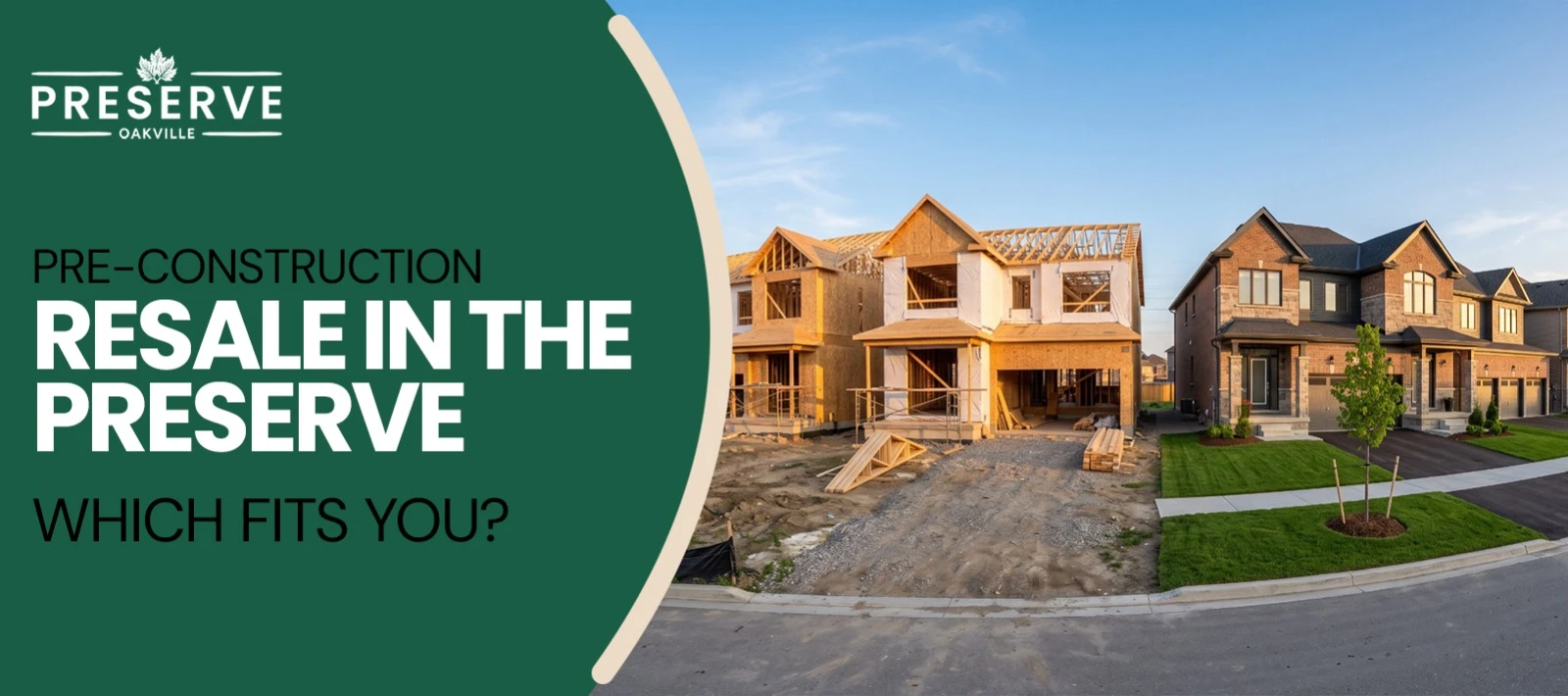
Two buyers can walk into The Preserve on the same weekend and look at completely different things. One tours a finished home on a street with mature fences and a school bus stop. The other stands in a sales centre looking at a floor plan, a site map and a model that will not look like their street for another couple of years. Both are buying in the same community, and both are making reasonable choices.
If you are deciding between pre-construction and resale in The Preserve, the question is less about which is better and more about which set of trade-offs fits your life. This guide walks through the differences that matter: cost, timing, financing, protection, living conditions and long-term value. It is written to hold up over time, so where figures or rules change often (rebates, mortgage limits, prices), we point you to the right place to check rather than quoting numbers that go out of date.
About The Preserve
The Preserve is a master-planned community in North Oakville, built in phases by large builders under the planning framework that governs development north of Dundas Street. It includes a mix of detached homes, semis, townhomes and some condominium buildings, with parks, trails, schools and commercial areas planned as part of the wider North Oakville area.
Because it is built in stages, some parts are fully established and others are still being developed. That is why the pre-construction versus resale question comes up so often here. You can often compare both options within the same neighbourhood and a short drive of each other.
Quick Comparison
Factor | Pre-construction | Resale |
|---|---|---|
Move-in | Usually well over a year after signing, and dates can move | Often 30 to 90 days after an accepted offer |
What you see | Plans, models and site maps | The actual home, inspected before you commit |
Price certainty | Price is set in the contract, but some costs can be added at closing | Price is what you negotiate, with fewer unknowns |
Customization | Choose finishes and options within the builder's limits | Buy as is, renovate later |
Deposit | Paid in stages over time | Due with the offer or very soon after |
Conditions | Builders rarely accept financing or inspection conditions | Financing, inspection and other conditions are normal |
Warranty | Builder warranty through Tarion | Remaining Tarion coverage if the home is still within its warranty years |
Surroundings | May be an active construction zone | Established streets, fences and trees |
Mortgage timing | Approval is tested again near closing | Approval is tested now |
Price and What You Are Actually Paying For
Comparing sticker prices is where most people start, and it can be misleading in both directions.
A new home's price is set when you sign, not when you close. If the market rises in between, you may be ahead. If it falls, you may find the home appraises for less than you agreed to pay, and your lender will only lend against the lower number (more on that below). With resale, you buy at today's price and know exactly what you are getting.
Look at what the price includes. A resale home usually comes with whatever the seller has already invested: finished basement, fencing, landscaping, window coverings, sometimes appliances. A new home often comes without some or all of those, so budget for them after closing. Compare the full cost of getting both homes to the same finished state, not just the purchase price.
Also compare price per square foot carefully. New homes tend to use space differently from older ones, and lot sizes and finishes vary, so a lower price per square foot does not automatically mean better value.
Timeline
Resale is fast. Once an offer is accepted and conditions are met, closings are commonly a matter of weeks to a couple of months.
Pre-construction takes much longer, typically a year or more and sometimes considerably more, because the home has to be approved, serviced and built. Closing dates are usually tentative at first and can be moved within the rules set out in the Tarion addendum to your contract. If you have a lease ending, a school year to hit, or a house to sell, build in a buffer or favour resale.
Deposits and Cash Flow
With a new build, deposits are normally paid in instalments over a period of months or longer. That spreads the cash demand and can suit buyers who are still saving or waiting to sell another property. The trade-off is that the money is tied up for a long time. Deposits are held in trust, and Tarion offers deposit protection up to a stated limit, so check how much of your deposit is covered.
With resale, the deposit is due with the offer or soon after, and the rest of your down payment is due on closing. You need the money sooner, but you also take possession sooner.
Closing Costs, Taxes and Fees
Closing costs differ in ways that surprise buyers, so ask about each of these early.
HST. New homes in Ontario carry 13% HST (5% federal and 8% provincial), while most resale homes do not. Relief for new homes has grown considerably, and it depends on the type of buyer, the price and the date you sign.
First-time buyers. The federal first-time home buyers' GST/HST rebate removes the 5% federal portion, up to $50,000, on new homes up to $1 million, with the relief phasing out between $1 million and $1.5 million. It applies to agreements signed within a set window that runs to 2030. Ontario also provides provincial relief of up to $80,000 for eligible first-time buyers, so the combined relief can reach $130,000.
All eligible buyers (temporary). Ontario's Enhanced New Housing Rebate extends up to $80,000 of provincial relief to repeat buyers and investors as well, and an Ontario top-up covers the federal 5% portion, up to $50,000. For agreements signed between April 1, 2026 and March 31, 2027, the combined relief is up to $130,000 on homes priced up to $1.5 million, phasing out as the price approaches $1.85 million. Builders apply it as a credit at closing.
Because the enhanced rebate is temporary, check the Ontario government and Canada Revenue Agency pages to see whether it has been extended or changed before you sign. Eligibility depends on factors such as using the home as your primary residence, and rental use is treated differently. Confirm in writing whether the price in your contract includes HST and how any rebate is applied.
Land transfer tax. Ontario charges provincial land transfer tax on both new and resale purchases, with a refund available to eligible first-time buyers. Toronto is the only Ontario municipality that charges its own on top, and Oakville does not. Confirm current rates and refund rules with the Ontario Ministry of Finance.
Development charges and levies. These are fees that the Town of Oakville and Halton Region charge to pay for roads, water, sewers, parks and other growth-related services, and in North Oakville they can add up to tens of thousands of dollars per home. They are set by by-law, change over time, and have been affected by provincial changes such as Bill 23, which changed how some charges are calculated and phased in. On a new home they are usually built into the price, but some contracts allow the builder to pass on increases or charge for certain items at closing. Ask your lawyer to check the clause carefully and, wherever possible, get a firm cap in writing. Without one, an increase in charges could land on you.
Other new-home closing items. These can include utility connection fees, grading or damage deposits, Tarion enrolment charges and legal costs related to the builder's documents. Ask for a list of every adjustment before you sign.
Property tax. A new home is often first billed on land only. Once MPAC assesses the finished home, the municipality can issue supplementary tax bills that cover the period you were already living there. Set money aside from the start so a backdated bill does not catch you off guard. A resale home already has an assessment, so your tax bill is easier to predict.
Community fees. Some townhome and condo formats in The Preserve may involve common element or maintenance fees, for example for shared roads or amenities. Ask whether the home you are considering has them, what they cover and how they can change.
Financing
Pre-construction. A mortgage pre-approval at signing is only a starting point. Most lenders will test your finances again close to closing, using the income, credit, debts and rules in effect at that time. Rate holds are limited, so special builder or long-hold programs may be needed to protect your rate for longer, usually with their own terms. If your circumstances change or rules tighten, you could face a smaller mortgage than expected while still being bound to the contract.
Appraisal risk. Lenders lend against the lower of the price and the appraised value. If the home appraises below your contract price at closing, you must cover the difference in cash. This is one of the biggest risks of buying long before closing, and it matters most when the market has softened or prices at signing were high.
Mortgage rules. Since December 2024, federal rules allow insured mortgages (less than 20% down) on homes priced up to $1.5 million, up from $1 million. Insured mortgages can also use a 30-year amortization for first-time buyers and for anyone buying a newly built home, whether or not they have owned before. The minimum down payment is 5% of the first $500,000 and 10% of the portion between $500,000 and $1.5 million. Homes priced above $1.5 million need at least 20% down. These rules are set by the federal government and can change, so confirm them with a mortgage broker, lender or CMHC before you decide, and again before you close.
Government savings plans. Programs such as the First Home Savings Account and the Home Buyers' Plan have rules on timing and occupancy that can matter if your closing is far off. Ask the CRA or your advisor how the rules apply to a home that is not yet built.
Warranty and Protection
New homes in Ontario come with a statutory warranty administered by Tarion. In broad terms it covers workmanship and materials in the first year, a longer period for items such as water penetration and certain systems and building envelope issues, and seven years for major structural defects. Builders are licensed and regulated by the Home Construction Regulatory Authority (HCRA), which handles licensing, builder conduct and complaints about the builder. Tarion handles the warranty itself: enrolment, warranty claims, delayed closing compensation and deposit protection. Before buying, look up the builder on the HCRA's public register and in the Ontario Builder Directory to see their licence status and record, and use Tarion for warranty claims and coverage questions. Buyers of new freehold homes are also asked to register their purchase with Tarion within 45 days of signing to qualify for full deposit protection, a requirement introduced in 2026, so ask your lawyer to handle or confirm it.
Warranty coverage stays with the home, so a resale buyer in a home that is still within its warranty years may benefit from the remaining coverage. Confirm what remains and how to make a claim with Tarion rather than assuming.
Be realistic about what the warranty does. It sets a process and time limits for builders to fix covered defects, and it does not make a new home free of problems. Document everything in writing, and keep your claim forms and deadlines organized.
A resale home that is out of warranty puts the risk on the buyer, which is why inspection matters more.
Contracts and Legal Differences
A pre-construction agreement is usually drafted by the builder and is longer and more complicated than a resale offer. It is worth paying a lawyer experienced in new homes to review it before you sign. Points to focus on:
Tarion addendum. It sets out closing dates, how they can be changed and what compensation you may receive for certain delays. Compensation is capped, so understand the limits.
Builder's right to terminate. Contracts can allow the builder to cancel under certain conditions, such as not obtaining approvals or financing.
Price adjustments. Look for clauses that allow additional charges or adjustments at closing.
Assignment. Whether you can sell your contract before closing, whether the builder must consent, and what fees apply.
Conditions. Builders generally do not accept conditions for financing, inspection or the sale of your current home. Resale buyers can include them.
Cooling-off period. For new condominium units, Ontario law provides a cooling-off period after you receive the required documents. For freehold homes, there is generally no statutory cooling-off period. Some townhomes in the area are sold with common elements, so ask your lawyer whether a cooling-off period applies to the specific home you are buying and do not assume.
Inspections
On resale, a professional home inspection before you finalize the deal is standard. For a home that is several years old, ask the inspector to look closely at grading and drainage, the foundation and basement, roof condition, windows and seals, and the age and condition of the furnace, air conditioner and other mechanical equipment, which may be nearing the end of their life.
On a new build, you do a pre-delivery inspection (PDI) with the builder's representative shortly before closing. Record every defect, scratch and missing item on the PDI form, because it becomes the starting record for warranty claims. Many buyers hire an independent inspector to help, particularly since problems found now are far easier to resolve than those found later.
Being new does not mean being flawless. Production schedules can lead to missed details, so inspect new homes as carefully as old ones.
Living in the Community
Construction. If you buy pre-construction in an area still being built, expect noise, dust, trucks and temporary conditions for as long as neighbouring homes and roads are under construction. Parks, sidewalks, planting and final road surfaces may not be finished when you move in. Ask the builder and the Town of Oakville what is planned for your block and the phases around it, and when.
Lots and privacy. Compare the actual lot, not just the home. Lot depth, backyard size, what backs onto the property and how close neighbours are all affect how the home lives. In general, a more established area gives you grown trees and defined fences. A new area gives you a blank slate but takes years to mature. Look at the survey and the site plan.
Layout. Newer designs often favour open-plan main floors and higher ceilings, and sometimes trade away storage. Older resale designs may have more defined rooms and different storage. Walk through both with your daily routine in mind.
Getting around. Test the commute at the times you will actually travel, in both directions, and see how it changes as nearby roads and transit are completed. Proximity to schools, parks, trails and shopping may also differ by phase.
If You Are Thinking About Investment
Appreciation is not guaranteed. A pre-construction purchase can gain value between signing and closing, but it can also lose value, and the gap shows up as an appraisal shortfall. Resale gives you today's market and cash flow from day one.
Rental. Understand the carrying cost against realistic rent, including property tax, insurance, maintenance and mortgage interest. Higher-priced homes often generate modest returns relative to the price, so many owners treat them as long-term holdings.
Assignments and flipping. Selling a new-home contract before closing can have significant tax consequences. Federal rules treat many properties sold within a short holding period as business income, and assignments may involve HST. Speak to an accountant before you sign if resale is part of your plan.
Secondary suites. Ontario rules on additional units in homes have been expanding, and the Town of Oakville administers zoning and building permits. Check what is permitted on your lot, what the builder allows or prepares for, and whether any registered restrictions, community rules or common element arrangements apply. If a legal basement apartment is part of your plan, confirm this before purchase, including ceiling height, separate entrance, egress and fire separation requirements under the Ontario Building Code. As a general baseline, a basement suite needs a finished ceiling height of at least 1.95 metres (about 6 feet 5 inches) over the required living areas, and a bedroom window used for escape needs an unobstructed opening of at least 0.35 square metres. Other requirements apply, and the Town of Oakville's building department has the final word, so check before you buy, since basement heights and window sizes vary from home to home.
Who Each Option Suits
Pre-construction may suit you if you have a long runway and flexible dates, want to choose finishes and layout, would like a newer home with newer building standards, and are comfortable with the financing and appraisal risk.
Resale may suit you if you need to move on a fixed date, want to see and inspect exactly what you are buying, want conditions to protect you, prefer an established street, or want to rent the home out quickly.
Neither is a better investment on its face. The right choice depends on your timing, your finances and how much uncertainty you can carry.
Common Myths
"Pre-construction is always cheaper." Not necessarily. Builders price in time and risk, and extra costs can appear at closing. Compare total costs, not just the headline price.
"New means no problems." New homes can have defects, which is why the PDI and warranty process exist.
"The price can't change after I sign." The base price is fixed, but your contract may allow certain adjustments and charges. Read the clauses.
"I'll just cancel if my plans change." Walking away from a binding pre-construction contract can cost you your deposit and potentially more.
"A pre-approval guarantees my mortgage." It does not. Your finances are tested again close to closing.
"Resale homes are always older and worse." In an area like The Preserve, a resale home may be only a few years old and can come with more finished space than a new build, so it needs to be assessed on its own merits.
Questions to Ask Before You Decide
What is the full list of costs and adjustments between signing and moving in?
Is HST included in the price, and how is any rebate handled?
Are development charges and levies capped in the contract?
How is my deposit protected, and up to what amount?
What happens if the closing date moves, and what compensation applies?
Can I assign the contract, and under what conditions and fees?
What will the area around my home look like for the next few years, and who is building it?
If I buy resale, how old are the roof, furnace, air conditioner and windows?
What would my mortgage look like if rates or rules change before closing?
What would I do if the home appraised for less than I agreed to pay?
Where to Check the Details That Change
Rules, rebates and prices change over time. Use this list to confirm the current situation before you make a decision.
Topic | Where to check |
|---|---|
HST and new home rebates | Canada Revenue Agency, Ontario Ministry of Finance |
Land transfer tax and refunds | Ontario Ministry of Finance |
Mortgage rules, down payment, amortization | Your lender or broker, CMHC, Department of Finance Canada |
New home warranty, claims, delayed closing and deposit protection | Tarion |
Builder licence, conduct and complaints | HCRA (public register), Ontario Builder Directory |
Zoning, secondary suites, development charges, local plans | Town of Oakville |
Property assessment and tax | MPAC, Town of Oakville |
Current prices, incentives and availability | The builder, a licensed real estate professional |
Final Thoughts
If you only read one part of this guide, make it this one. Pre-construction and resale in The Preserve are both sound ways to buy, and they trade off different things.
Pre-construction gives you a newer home, a say in finishes and layout, and a deposit spread over time. In return you wait longer, carry the risk that your mortgage or the home's appraised value changes before closing, and may live next to active construction. Added costs such as HST, levies, taxes billed after assessment and finishing work can also move the real price well beyond the number on the contract.
Resale gives you speed, a home you can see and inspect, the ability to add conditions, and an established street. In return you pay today's price, you need your funds sooner, and an older home may need updates to the roof, furnace, windows or finishes.
Whichever way you lean, a few steps protect you. Price the full cost of each option, not just the headline number. Confirm your financing in writing and plan for a lower appraisal. Have a lawyer read any builder contract before you sign. Check the builder's record with Tarion and the HCRA. Inspect the home carefully, new or not. Rules, rebates and prices change, so verify them with the sources listed above before you commit.
In short, choose pre-construction if you have time, flexibility and a financial cushion. Choose resale if you need certainty, a firm move-in date or the protection of conditions. If you are not sure which describes you, talk to a licensed real estate professional, a mortgage advisor and a lawyer before you decide.
FAQs
Is it better to buy pre-construction or resale in The Preserve?
It depends on your timing, budget and tolerance for uncertainty. Pre-construction offers choice and a newer home but takes longer and carries financing and appraisal risk. Resale offers speed and certainty.
How long does a pre-construction home take to close?
Usually more than a year, and sometimes longer. Dates can move within the rules in your contract, so plan with a buffer.
Do resale homes pay HST?
Most resale homes do not. New homes are generally subject to HST, with rebates that depend on current rules and your situation.
Does Oakville charge its own land transfer tax?
No. Toronto is the only Ontario municipality that does. Provincial land transfer tax still applies.
Does the new home warranty transfer to the next owner?
Warranty coverage stays with the home for the remaining term. Check with Tarion for details.
Can I back out of a pre-construction contract?
Not freely. Depending on the type of home, there may be a limited cooling-off period. Otherwise you are bound, and backing out can mean losing your deposit.
What happens if my new home appraises for less than I paid?
Your lender will only lend against the lower value, so you must make up the difference in cash at closing.
Should I get a home inspection on a new build?
Yes. A professional inspection or at least a careful PDI helps you catch issues while the builder is still responsible for fixing them.
Can I add a basement apartment in The Preserve?
Often possible, but it depends on your lot, the Town of Oakville's rules, the Ontario Building Code and any restrictions that apply to your home. Confirm before you buy.
Is a pre-construction home a good investment?
It can be, but it is not guaranteed. Outcomes depend on the market between signing and closing, your financing, and your carrying costs.
This article is general information, not legal, tax, mortgage or financial advice. Rules, programs and prices change. Confirm details with a lawyer, accountant, mortgage professional and the organizations named above before making a decision.
Recent Blogs

Elementary Schools in The Preserve Oakville & Homes Nearby
October 13, 2026
Read More
Living in The Preserve Oakville: Commute, GO & Home Values
October 12, 2026
Read More
First-Time Home Buyer's Guide to Preserve Oakville
October 8, 2026
Read More
Property Transfer & Closing Costs in Oakville: Buyers Guide
October 7, 2026
Read More