
Oakville Tree Removal Permit: Rules for Private Trees on Your Lot
November 14, 2026
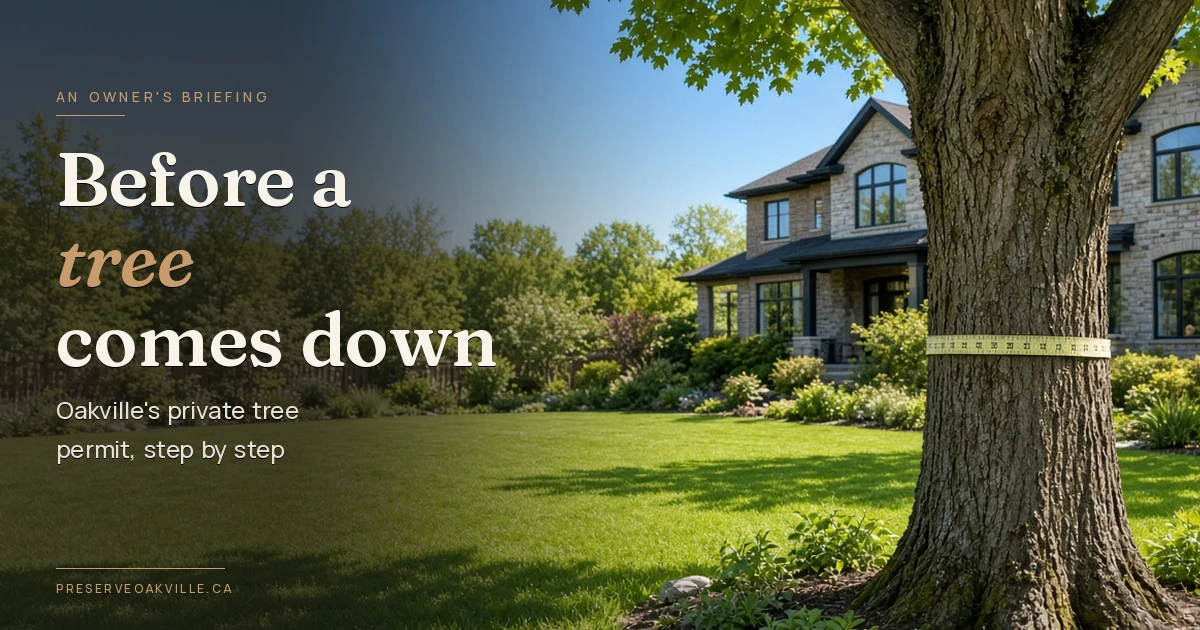
A storm splits a limb off the big maple behind the house. A new owner wants more sun on the vegetable bed. A pool contractor says the spruce near the back fence is “in the way.” In each case, the same question comes up before anyone starts a chainsaw: does the Town of Oakville need to approve this?
For most established trees on private property, the answer is yes. Oakville’s Private Tree Protection By-law (By-law 2017-038, as amended) applies to private land across the town, and the Town’s application page states plainly that a private tree removal permit is required to remove any tree with a diameter of 15 centimetres or more at breast height. That threshold catches far more trees than many owners expect, including the mid-sized trees planted when a subdivision was new.
The Private Tree Removal Permit Application Process, the Private Tree Protection By-law page, and the Private Tree Protection Procedure. Fees and deposits are quoted as they appeared on that date. They can change with the Town’s annual rates and fees, so confirm them before you apply.
The Short Version
A permit is needed to remove any private tree measuring 15 cm or more in diameter at breast height (DBH), any hedge with stems of 15 cm or more, any tree that had to be kept or planted as a condition of an approved site plan, and any tree planted through the Town’s partnership program for larger replacement street trees on private property (Town of Oakville, Private Tree Removal Permit Application Process).
DBH is measured 137 cm above the ground. The Town says a trunk with a circumference of 47 cm or less at that height is under 15 cm DBH, so no permit is needed to remove it.
Dead trees, high-risk trees, ash trees and buckthorn still need a permit, but the Town lists them as fee-exempt.
On the date reviewed, the non-refundable fee was $65 for the first tree of 15 to 24 cm DBH removed in a 12-month period, and $425 for each additional tree and for any tree larger than 24 cm DBH. Removals tied to a development application carry a higher fee.
Replacement planting is a common condition: one tree for every 10 cm DBH of healthy tree removed, with a $300 security deposit for each tree to be planted.
The by-law does not apply to woodlands or greenlands governed by the Halton Region Tree By-law 121-05 (Town of Oakville, Private Tree Protection By-law).
Non-compliance can lead to charges under the Town’s Administrative Penalty By-law 2021-038.
Which Trees the by-law Reaches
The by-law is about private trees. Trees on Town land, including many boulevard trees between the sidewalk and the road, fall under a separate municipal tree by-law (By-law 2009-025, which the Town’s pool permit guidelines describe as regulating the planting, care, maintenance and removal of trees on Town property). If a tree sits near your front lot line, its ownership is the first thing to settle, because a different process applies to a Town tree.
The 15 cm threshold
Fifteen centimetres of diameter is not a large tree. The Town’s own conversion makes the point: wrap a tape around the trunk at 137 cm above the ground, divide the circumference by 3.14, and you have the diameter. A trunk that measures more than 47 cm around at that height is over the threshold. Many trees planted as saplings in a newer subdivision pass that size well within the time an owner holds the house.
The same threshold applies to hedges. The Town’s page lists any hedge with stems that measure 15 cm or more in diameter as needing a permit, which matters on older properties where a cedar row has grown into a line of trunks.
Trees protected by a planning condition
Size is not the only trigger. A tree that was required to be retained or planted as a condition of an approved site plan needs a permit regardless of diameter, and so does a tree planted through the Town’s partnership program for larger caliper replacement street trees on private property. A buyer may not know a tree has that history. The seller, the builder’s documents, or the Town are the places to ask.
Shared trees on a property line
The Town’s procedure defines a boundary tree as one whose trunk grows across one or more private property lines. To remove it, the applicant must include a signed letter of consent from the neighbouring owner. The online form asks directly whether any trunk is on a property line. A fence is not a reliable guide to where that line runs; a survey is.
Woodlands and greenlands
The Town’s by-law page states that it does not apply to woodlands or greenlands governed by the Halton Region Tree By-law 121-05. Properties that back onto natural areas can sit next to land managed under different rules, and Conservation Halton may also have a role where work involves excavation near valleylands or wetlands. Our earlier note on buying beside conservation land in The Preserve covers how to confirm that with official mapping and a property inquiry.
What the Town looks at, and What it Costs
How an application is assessed
Under the Private Tree Protection Procedure, staff visit the site to assess tree ownership, health, structure, risk rating, location, and any conflict with infrastructure. They also calculate the property’s tree canopy cover before and after the proposed removal (Town of Oakville, Private Tree Protection Procedure).
The Town scores each request against a set of criteria and indicators: species, health, location, risk rating, leaf area, and the canopy cover that would remain. The procedure describes three outcomes:
Score | Outcome described by the Town |
|---|---|
Less than 30 | Removal granted without a replacement condition |
30 to 50 | Removal granted with a replacement condition |
More than 50 | Removal denied; the owner may apply again 12 months after the denial |
The procedure ties those scores to the Town’s canopy goals, including its 40 per cent town-wide canopy objective. It also contains a line that matters for owners in The Preserve and the rest of North Oakville: the removal of trees in residential lands north of Dundas Street “will be approved with tree replacement condition as defined in Schedule A” of the by-law. In other words, a buyer north of Dundas should plan on replacement planting as part of an approved removal.
Two species are treated differently. To improve diversity and reduce invasive species, the procedure says removal of Norway maple and tree of heaven will be approved with a replacement condition. Dead trees with a high-risk rating and invasive buckthorn are granted without a permit fee and without a replacement condition once inspected and approved.
Fees as Published on 13 November 2026
Item | Amount on the Town’s page |
|---|---|
First tree removed (15 to 24 cm DBH) in 12 months | $65, non-refundable |
Each additional tree, and any tree larger than 24 cm DBH | $425, non-refundable |
Removal resulting from a development application (second tree of 15 to 24 cm DBH in 12 months, and any tree larger than 24 cm DBH) | $900, non-refundable |
Dead and high-risk trees, ash trees, buckthorn | No fee, but a permit is still required |
Security deposit for each replacement tree | $300, refunded after a final inspection of the replacement planting |
The fees cover consultation and administration. The Town points applicants to its rates and fees page for current amounts.
Replacement planting rules
When replacement is a condition, the Town’s page sets out the standard:
One tree must be planted for every 10 cm DBH of healthy tree removed.
Replacement trees must be planted on the same private property where trees are removed. Cash in lieu is accepted only where there is not enough space on the property, and those funds go to planting on municipal land.
The minimum size is a 30 mm caliper deciduous tree, or a 150 cm high coniferous tree in a five-gallon container, balled in burlap, or in a wire basket.
Cedar is accepted as a replacement only when a cedar was approved for removal. The Town publishes a list of eligible species for replacement.
The arithmetic deserves a moment before you apply. Removing one healthy 40 cm tree, under that one-per-10-cm rule, implies four replacement trees and four $300 deposits, and the yard needs room for them. The deposits come back only after the Town inspects the planting.
Construction, Pools and Additions
A large share of tree permits come from projects rather than from a single tree. The procedure requires an arborist report endorsed by a certified and licensed arborist when a removal results from a development application, and it lists demolition, renovations, pools, landscaping, and other property construction projects as examples.
Tree protection zones
Trees that stay on a construction site, and neighbouring trees within six metres of the work, must be protected with barriers set at the Town’s tree protection zone (TPZ) distances. The TPZ is measured from the outside edge of the trunk base. The procedure’s table begins this way:
Trunk diameter (DBH) | Minimum TPZ distance from the trunk |
|---|---|
Under 10 cm | 1.8 m |
10 to 30 cm | 2.4 m |
31 to 50 cm | 3.0 m |
51 to 60 cm | 3.6 m |
61 to 70 cm | 4.2 m |
71 to 80 cm | 4.8 m |
81 to 90 cm | 5.4 m |
91 to 100 cm | 6.0 m |
For trees over 100 cm DBH, the procedure adds 10 cm of TPZ for every centimetre of DBH. No grade change, storage of materials or equipment is permitted inside the zone, and the barriers must stay in place for the whole project until the Town authorizes their removal. Where a design truly cannot avoid the zone, the applicant has to show with supporting documents that the effect on the anchor roots stays within acceptable limits.
What an arborist report must contain
For a high-risk tree, the procedure asks for a report from a certified arborist licensed by the Town that includes species, location, DBH measured at 1.37 m, crown spread, and a minimum level 2 tree risk assessment with photographs. For trees on a construction site, the list is longer: an inventory referenced to the address and ownership, health notes, a rationale for each removal, protection alternatives, a tree protection plan drawing, and the approved grading and servicing plans. Owners planning a larger project, such as those described in our piece on secondary suites and home additions in The Preserve, should bring the arborist in early, before the design is fixed.
A Working Sequence
Confirm ownership. Decide whether the tree is on your lot, on a shared line, or on Town land. Use your survey, and contact ServiceOakville at 905-845-6601 if the location is unclear.
Measure. Take the circumference at 137 cm above ground. More than 47 cm around means a permit is needed.
Gather documents. An arborist report for a high-risk tree or a development-related removal; the owner’s signed authorization if someone else applies; the neighbour’s signed consent for a boundary tree. The Town publishes sample declaration forms.
Apply online. The application runs through the Town’s online services and requires a Town account. You describe the work, the number of trees, the reason, the location on the lot, and the species if known. The Town suggests tying a string around the tree so the inspector can identify it.
Meet the inspector. The Town says a tree inspector from its Forestry Section will contact you within five business days to arrange an on-site consultation.
Read the decision letter. It sets out which trees may be removed, which are denied, which must be protected, and any replacement condition.
Pay and collect. Take the fees, the security deposit and the signed decision letter to ServiceOakville at Town Hall, 1225 Trafalgar Road. For fee-exempt removals of dead, high-risk or ash trees, the inspector leaves the permit on site.
Post the permit. Display it on the property, visible from the road, for five days before and including the day of removal.
Hire a licensed arborist. The Town does not remove trees from private property, and the procedure defines the qualifications of a certified and licensed arborist. The Town keeps a list of licensed contractors.
Plant and close out. Plant the replacement trees and book the final inspection so the deposits can be released.
Emergencies
The Town’s page allows emergency removal without a permit where there is an immediate risk that the tree will cause serious injury or damage to people or property. You must still notify the Town as soon as possible. A leaning tree that has stood that way for years is unlikely to meet that test; a trunk split in last night’s storm may.
Points Worth Double-Checking
“Dead” is not the same as “no permit.” Dead, high-risk, and ash trees are fee-exempt, but the Town’s page still requires a permit for them.
The threshold is diameter, not height. A modest-looking tree can exceed 15 cm DBH. Measure before you book a contractor.
Pruning is a separate question from removal. The by-law regulates injury as well as destruction. If work goes beyond normal pruning, ask the Town before it starts.
A seller’s promise is not a permit. If an agreement of purchase and sale anticipates a tree coming down, the buyer still needs the Town’s approval after closing, and the replacement condition still applies.
Replacement space is real space. North of Dundas Street, plan on a replacement condition. Check that the lot can accommodate the trees before committing to a pool or patio layout.
Contractor licensing. The Town’s pool permit guidelines state that pool installers, landscaping companies and arborists working in Oakville must be licensed by the Town.
Fees change. The amounts above are a snapshot from 13 November 2026.
What to do with this
If you are buying a home with mature trees, ask early whether any removals or planting conditions are already in progress, and walk the yard with your plans in mind. If you already own the house, measure the tree, confirm ownership, and open the online application before you sign a contract with an arborist or a pool builder. Build the replacement planting and the deposit into the project budget, and keep the decision letter and inspection results with your property records.
This article is general information based on Town of Oakville pages reviewed on 13 November 2026. It is not legal, arboricultural or planning advice. The by-law, the procedure and the Town’s current rates and fees govern, and Town staff can confirm how they apply to a specific property.
FAQ
Do I need a permit to cut down a tree on my own property in Oakville?
Usually, if the tree is 15 cm or more in diameter at breast height (137 cm above the ground). The Town also requires a permit for hedges with stems of 15 cm or more, trees kept or planted as a site plan condition, and trees planted through its partnership program, regardless of size.
How do I know if my tree is over 15 cm?
Measure the trunk’s circumference 137 cm above the ground and divide by 3.14. The Town says a trunk that measures 47 cm or less around at that height is under 15 cm DBH and can be removed without a permit.
How much does a private tree removal permit cost in Oakville?
On 13 November 2026, the Town listed $65 for the first tree of 15 to 24 cm DBH in a 12-month period and $425 for each additional tree and for trees larger than 24 cm DBH. Development-related removals cost more. Dead, high-risk, and ash trees, and buckthorn, were fee-exempt.
Will I have to plant new trees?
Often. The Town requires one replacement tree for every 10 cm DBH of healthy tree removed when replacement is a condition, with a $300 security deposit per tree. Its procedure states that removals on residential lands north of Dundas Street are approved with a replacement condition.
Can I remove a tree in an emergency without waiting?
Yes, where there is an immediate risk that the tree will cause serious injury or damage to people or property. The Town says no permit is needed for an emergency removal, but you must notify the Town as soon as possible.
Who does the actual removal?
The property owner hires a licensed arborist. The Town does not remove trees from private property, and the permit must be posted on the site, visible from the road, for five days before and including the day of removal.
Tags
Recent Blogs
Is The Preserve Oakville A Good Place To Buy A Home In 2027?
November 15, 2026
Read More
Oakville Deck, Shed and Pool Permits: What Needs Town Approval
November 14, 2026
Read More
Home Insurance for Water Damage, Sewer Backup and Overland Flood
November 13, 2026
Read More
Buying a Home Beside Conservation Land in The Preserve Oakville
November 11, 2026
Read More