
Home Insurance for Water Damage, Sewer Backup and Overland Flood
November 13, 2026
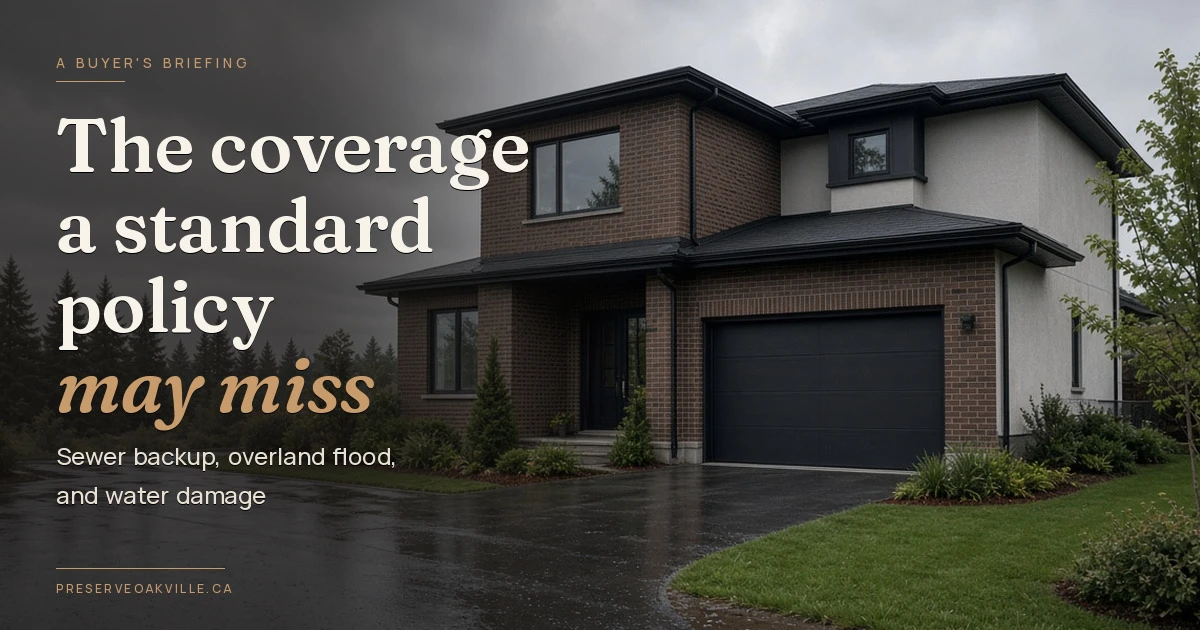
A standard home insurance policy is built around sudden, accidental damage. A burst pipe inside the house, water escaping from a broken water main, or rain entering through a hole that a storm has just torn in the roof often falls on the covered side of that line. Water that arrives another way — through a basement drain, across the yard after a river or a heavy rainfall, or up through the ground — often does not, unless a specific optional coverage has been added.
That distinction is easy to miss at closing, when the conversation is about whether a policy is in force so that a lender can advance funds. It becomes expensive after a basement flood, when the adjuster is asked which wording applies. The Insurance Bureau of Canada (IBC) has repeated the same core points in its public guidance through 2026: sewer backup and overland flood are typically not part of a standard policy, optional coverage is widely offered but is based on risk, and the only reliable confirmation is the policy wording and a conversation with the insurance representative.
The notes below follow IBC’s published explanations, plus official local tools for understanding flood hazard and stormwater in Oakville. They do not quote premiums, deductibles or claim statistics, because those figures vary by insurer, by property and by the date a quote is issued.
The short version
A typical home policy is meant to cover sudden and accidental loss. IBC states that it commonly covers sudden or accidental water damage from indoor plumbing, heating or air conditioning; water escaping from a malfunctioning appliance (but usually not the cost of repairing the appliance); damage from a broken water main; and interior damage from water that enters through a roof leak, though the roof itself is not covered if the leak is due to wear and tear or poor maintenance.
Damage caused by the backing up of sewers and drains is typically not covered by a standard policy. Optional sewer-backup coverage is offered by most insurers.
Overland flooding — IBC describes this as occurring when bodies of fresh water, such as rivers or dams, overflow onto dry land — is also typically not covered by a standard policy. Optional residential overland-flood coverage is now offered by many insurers for the majority of homes, based on risk, and is commonly combined with sewer-backup coverage.
Even if a house does not sit beside a lake or a river, it can still be damaged by surface or ground water. IBC makes that point explicitly.
Coverage may be limited or unavailable in a known flood plain or high-flood-hazard area. Policy wording, limits and deductibles decide the outcome, not the brochure name of a “water package.”
In Oakville, Conservation Halton’s flood-hazard and regulation-limit mapping, and the Town’s stormwater program, are the official local references for physical flood risk. They do not replace an insurance contract.
What a standard policy usually does, and does not, cover
IBC’s water-damage and flood-protection page, reviewed on 13 November 2026, is the cleanest official summary for a household that is not trying to parse a 40-page wording on its own. The starting rule is that insurance is meant to cover sudden and accidental loss or damage. Wear, poor maintenance, and water that arrives through an excluded path sit outside that rule unless an endorsement says otherwise.
On the typically covered side, IBC lists:
sudden or accidental water damage caused by indoor plumbing, heating or air conditioning
water damage caused by the malfunction of an appliance such as a washing machine or dishwasher, usually without covering the repair of the appliance itself
damage related to the escape of water from a broken water main, whether it occurs on or outside the property
water damage to the interior of a home caused by water entering through a roof leak, with the important qualification that the roof damage is not covered if it is due to wear and tear or poor maintenance
On the typically excluded or limited side, the same page, and IBC’s later 2026 Ontario flood bulletins, draw brighter lines:
Sewer backup: water damage in a basement due to sewer backup is only covered if specific, optional sewer-backup coverage has been purchased.
Overland flood: damage from a river or other body of water overflowing onto dry land is covered only if optional overland-flood coverage has been purchased. In an April 2026 bulletin, IBC added that if you live in a known flood plain or high-flood-hazard area, this coverage may be limited or unavailable. A July 2026 bulletin on flooding in Ottawa described the optional coverage as widely available in Ontario, but often including coverage limits, and again possibly unavailable in a known flood-plain or high-risk area.
Coastal flooding and storm surge: generally not covered by home insurance or by the usual optional endorsements.
Groundwater and seepage: IBC has noted that these are typically not standard coverages across all home policies. Some insurers offer them as optional endorsements, sometimes individually and sometimes as a bundle, at additional cost.
Frozen pipes: damage from freezing of indoor plumbing may not be covered if the house is left unheated while the occupants are away during the normal heating season, unless the conditions in the policy — such as draining the plumbing or having the home checked at required intervals — have been met. Freezing-related damage that occurs despite those precautions is typically covered.
Ice damming: sudden and accidental water damage from ice dams is commonly covered, but ongoing or repeated damage is treated as a maintenance issue and may not be covered. Basic policies may not cover ice-dam damage at all.
Wind damage to the house, including damage from flying debris or falling branches, and water that then enters through an opening the storm has created, is usually covered. Additional living expenses may be available if the household cannot stay in the home because of insured damage. Those are still subject to the policy’s terms.
The important reading habit is to separate the path the water took from the fact that the basement is wet. Sewage rising through a floor drain is a sewer-backup question. Rainwater flowing across a yard and in through a basement window is an overland-flood question. A pipe that bursts inside a wall is usually a standard-coverage question. A slow leak from a neglected roof is often a maintenance question. Insurers sometimes bundle optional protections under one product name. The name is not the coverage; the wording, exclusions, limits and deductible are.
Optional sewer backup and overland flood
Optional sewer-backup coverage is the endorsement most frequently overlooked in a newer community, because the houses are not old and the streets have modern storm and sanitary systems. IBC’s advice does not depend on the age of the house. Backup can still occur during an extreme rainfall, a blockage, or a municipal surcharge, and the standard policy typically does not respond without the endorsement.
Optional overland-flood coverage is newer in the Canadian market than fire or theft coverage, and IBC now describes it as offered by many insurers for the majority of homes, on a risk-rated basis. It is commonly sold together with sewer backup, but it is not automatically included just because one of the two is present. A household that lives well away from a named creek can still need it, because surface water from heavy rain or melting snow, and in some wordings groundwater, can enter at ground level.
IBC does not publish a single premium or a single sub-limit that every Ontario insurer must use, and this article does not invent one. Limits on optional flood coverage can be lower than the main dwelling limit. Availability can be restricted on a lot that sits in a mapped flood plain or a high-hazard area. The only figures that matter are the ones on the quote and the policy declarations for that address.
A mortgage lender generally requires home insurance as a condition of the loan. That requirement does not, by itself, require sewer-backup or overland-flood endorsements. If those endorsements matter to you, they have to be asked for and shown on the documents.
Local flood information is not the same as coverage
Physical flood risk and insurance coverage have to be checked separately. Conservation Halton prepares flood-hazard mapping for the creeks and valleys in its watershed, including in Oakville, and uses that work to support its regulation, planning, and flood-forecasting programs. The authority’s mapping materials, reviewed for this article, state that flood-hazard mapping does not create a hazard; it shows where the hazard already exists. A flood plain is land flooded by a nearby creek or lake during large storms. Spills occur when flood waters leave the valley and flood plain and move onto surrounding land.
The same mapping supports approximate regulation-limit mapping, which shows where a Conservation Halton permit may be required before development activity. That is a land-use and safety tool, discussed in more detail in the article on buying beside conservation land in The Preserve. It is also a useful screen before you buy insurance, because a lot that sits in or near a mapped flood plain is exactly the kind of property IBC flags as possibly facing limited or unavailable overland-flood coverage. The map does not tell you what your policy will pay.
The Town of Oakville manages the municipal stormwater system that carries rain and melted snow away from roofs, driveways and streets. In 2026 the Town introduced a dedicated stormwater fee so that this work is funded and shown as a separate Special Charge on the tax bill. The published 2026 residential amounts, as of 13 November 2026, are $137 a year for a detached home, $64 for a semi-detached home, and $30 for a townhome, condo or apartment, with higher full rates phased in by 2028. Paying that fee supports municipal infrastructure. It is not a substitute for optional insurance, and it is not a claim payment.
A buyer who wants a lot-level sense of physical risk can review Conservation Halton’s online mapping, ask the seller about any past water entry, and have a home inspector look at grading, window wells, downspouts and any existing sump pump or backwater valve. Those steps inform the insurance conversation; they do not bind an insurer.
Reducing the chance of a loss
IBC publishes a practical prevention list that is worth reading in full on its water damage and flood protection page. The items that most often apply to a house in a planned neighbourhood include: keeping valuables out of the basement; not pouring fats, oils and grease down drains; raising large appliances, furnaces, hot-water heaters and electrical panels above anticipated flood levels where that is possible; using water-resistant materials below ground level; installing a sump pump with a battery backup; installing a backwater valve as recommended by the municipality; reducing water use during and just after heavy rain; keeping eavestroughs and downspouts clear; extending downspouts at least six feet from the basement wall; grading so that water drains away from foundation walls; and keeping snow and water out of window wells.
IBC notes that some municipalities may offer subsidies for backwater valves, that legal requirements set by the municipality must be followed, and that some insurers may provide incentives for valves or sump pumps. This article does not list a current Oakville subsidy amount, because that would need a current official program page of its own. Ask the Town or Halton Region about any program that is open at the time of the work, and ask the insurer whether a discount is actually available on that policy.
Prevention does not create coverage that was never purchased. It can, however, be a condition of coverage, or a reason an insurer is willing to offer an endorsement in the first place.
A working sequence
Before closing, or at the next renewal, read the policy declarations and the wording for water, sewer backup, overland flood, groundwater or seepage, frozen pipes and additional living expenses. Note any sub-limits and deductibles.
Ask the insurance representative, in writing if possible, whether sewer backup and overland flood are included, optional, limited or unavailable at that address, and whether groundwater or seepage needs a further endorsement.
Look at Conservation Halton’s mapping for the lot, and ask the seller or the inspector about any previous water entry, sump pump, backwater valve or grading problem.
If optional coverage is available and you want it, have it added before the closing date or the renewal date, and keep the updated declarations with the property records.
After you move in, work through IBC’s prevention list: downspouts, grading, window wells, a sump pump with backup power, and a backwater valve where the municipality and the insurer recommend one.
If water does enter the home, photograph the path it took, call the insurer promptly, and do not assume a “flood” in ordinary speech is the same as a flood in the policy.
Points worth double-checking
Assuming that a lender’s insurance requirement already includes sewer backup and overland flood.
Treating a product name such as “water protection” as proof that both endorsements, and groundwater, are present.
Using a neighbour’s claim experience, or the absence of a nearby creek, as a substitute for the wording on your own policy.
Leaving the house unheated in winter without following the policy’s checking or draining requirements.
Confusing the Town’s stormwater fee, or a conservation-authority map, with an insurance payment.
Waiting until after a rainfall to ask whether optional coverage is available; in a mapped high-hazard area it may be limited or not offered at all.
What to do with this
The coverage question is narrower than it first appears. A standard policy does a specific job. Sewer backup and overland flood are different jobs, usually sold as options, sometimes capped, and sometimes declined on higher-risk lots. The official IBC explanations, the policy wording, and the local hazard maps are enough to have a precise conversation with an insurance representative before you rely on the policy.
Current homes for sale in The Preserve should be underwritten address by address, including for new homes that have not yet had a first renewal. A home evaluation and the closing-costs article deal with price and transaction costs; they do not rank insurers or quote premiums.
This article is general information based on Insurance Bureau of Canada guidance and official Town of Oakville and Conservation Halton pages reviewed on 13 November 2026. It is not insurance, legal or financial advice. Policies differ. Confirm the coverage, limits and exclusions on the actual policy, and speak with a licensed insurance representative about a particular address.
Questions answered
Does a standard Ontario home policy cover a flooded basement?
It depends on how the water got in. IBC states that basement damage from sewer backup is covered only with optional sewer-backup coverage, and that overland flood is covered only with optional overland-flood coverage. A burst indoor pipe is typically a different, often standard, coverage question.
I do not live beside a river. Do I still need overland-flood coverage?
Possibly. IBC notes that even if you do not live by a lake or a river, a home can still experience flood damage from surface or ground water, and that optional coverage is risk-rated and may be combined with sewer backup.
Will I be able to buy overland-flood coverage on every lot?
Not necessarily. IBC has said that in a known flood plain or high-flood-hazard area, this coverage may be limited or unavailable. The insurer’s decision is made for the address, not for the neighbourhood name.
Is the Town’s stormwater fee a form of flood insurance?
No. The fee funds municipal stormwater infrastructure and appears as a Special Charge on the Oakville tax bill. It does not pay a homeowner’s insurance claim.
Does my mortgage force me to buy sewer-backup coverage?
A lender usually requires home insurance, but that requirement does not automatically include sewer-backup or overland-flood endorsements. Those have to be added if you want them and if the insurer will offer them.
What should I do first after water enters the house?
Document the source if you can do so safely, notify the insurer promptly, and follow the policy’s claims instructions. IBC also advises that additional living expenses may be available if insured damage makes the home unusable, subject to the policy.
Tags
Recent Blogs

Is The Preserve Oakville A Good Place To Buy A Home In 2027?
November 15, 2026
Read More
Oakville Deck, Shed and Pool Permits: What Needs Town Approval
November 14, 2026
Read More

Oakville Tree Removal Permit: Rules for Private Trees on Your Lot
November 14, 2026
Read More
Buying a Home Beside Conservation Land in The Preserve Oakville
November 11, 2026
Read More