
Property Transfer & Closing Costs in Oakville: Buyers Guide
October 7, 2026
Most buyers plan around the down payment and the mortgage, then find out late in the process that closing day needs a lot more cash. Closing costs are the taxes, fees, and adjustments you pay on top of the purchase price when the sale completes. Almost all of them go through your lawyer, and almost all of them have to be paid in cash.
In Oakville, one cost stands out from the rest: the Ontario land transfer tax. On the prices common in town, it is often the largest single item by a wide margin. This guide explains how it's calculated, what the other costs are, and what changes if you're buying a new build or a condo in North Oakville.
A quick note on numbers. Tax brackets, rebates, and fees get updated from time to time. The figures below are the rules and typical amounts at the time of writing, so confirm them with your real estate lawyer before you set your budget.
Planning your mortgage and down payment is only half the battle—understanding Property Transfer & Closing Costs in Oakville is what prevents last-minute financial surprises. From Ontario land transfer tax to legal fees, here is the exact breakdown of what you’ll actually pay before getting your keys.
How Much Are Closing Costs in Oakville?
Closing costs vary with the price of the home, whether you qualify for a rebate, whether the property is new or resale, and whether it's freehold or a condo. A fixed number would be misleading, but a range helps with planning.
What Are Closing Costs?
Closing costs are the one-time expenses a buyer pays to complete a home purchase, on top of the down payment. In Ontario they include land transfer tax, legal fees, title insurance, and adjustments for prepaid property taxes and utilities. Most must be paid in cash on closing day.
A Realistic Budget Range
Many lenders ask you to show savings of around 1.5% of the purchase price for closing costs. That's a minimum for qualifying, and in Oakville it often falls short of the real total. Land transfer tax alone comes to roughly 1.7% to 1.8% of the price on a home between $1.2 million and $1.5 million, before any rebate.
For planning, many buyers set aside somewhere between 2% and 4% of the purchase price. The lower end fits a first-time buyer who gets the rebate on a resale home. The higher end fits a buyer with no rebate, or someone buying a new build with extra charges from the builder.
Closing Costs at a Glance
Cost | Who Collects It | Notes |
|---|---|---|
Land transfer tax | Province of Ontario, through your lawyer | Usually the largest item |
Legal fees and disbursements | Your real estate lawyer | Flat fee plus government and search charges |
Title insurance | Insurer, arranged by your lawyer | One-time premium |
Property tax and utility adjustments | Seller, through the Statement of Adjustments | Depends on what the seller prepaid |
Home inspection | Inspector | Paid before you remove conditions |
Appraisal | Lender or appraiser | Sometimes covered by the lender |
Sales tax on mortgage insurance | Province of Ontario | Only if you put down less than 20% |
Builder charges and HST items | Builder | New builds only |
Can You Roll Closing Costs Into Your Mortgage?
In most cases, no. Land transfer tax, legal fees, and adjustments are paid in cash through your lawyer. The mortgage insurance premium itself can be added to your loan, but the provincial sales tax on that premium cannot. Plan to have the cash in your account before closing day.
Ontario Land Transfer Tax: How It's Calculated
The Ontario land transfer tax is a marginal tax. Each slice of the price is taxed at its own rate, similar to income tax brackets. Buyers pay it, and sellers do not.
Provincial Land Transfer Tax Rates
These are the rates for a home with one or two single-family residences, at the time of writing.
Portion of the Purchase Price | Rate |
|---|---|
First $55,000 | 0.5% |
$55,000 to $250,000 | 1.0% |
$250,000 to $400,000 | 1.5% |
$400,000 to $2,000,000 | 2.0% |
Over $2,000,000 | 2.5% |
How to Calculate It Step by Step
The first three brackets add up to $4,475 on the first $400,000 of the price. For a home priced between $400,000 and $2 million, the quick formula is:
Take the purchase price and subtract $400,000.
Multiply that amount by 2%.
Add $4,475.
Here's how that works at three price points, with the first-time buyer rebate shown separately.
Purchase Price | Land Transfer Tax | After the $4,000 First-Time Buyer Rebate |
|---|---|---|
$800,000 | $12,475 | $8,475 |
$1,200,000 | $20,475 | $16,475 |
$1,500,000 | $26,475 | $22,475 |
For example, on an $800,000 home you subtract $400,000 to get $400,000, multiply by 2% to get $8,000, and add $4,475. The tax is $12,475.
Does Oakville Have a Municipal Land Transfer Tax?
No. Oakville and the rest of Halton Region don't charge a municipal land transfer tax. Buyers in Bronte, Glen Abbey, Joshua Creek, River Oaks, The Preserve, and every other part of town pay only the provincial tax. Your lawyer collects it on closing day and pays it when the deed is registered.
First-Time Buyer Land Transfer Tax Rebate
Ontario gives eligible first-time buyers a rebate on the provincial land transfer tax. It's applied by your lawyer on closing day, so you don't have to wait for a refund in most cases.
How the Rebate Works
The rebate is capped at $4,000. It covers the full tax on homes priced up to about $368,000 (the exact break-even point works out to roughly $368,333). Above that price, the tax is higher than the rebate, so you pay the difference. On most Oakville purchases the rebate reduces the bill but doesn't remove it.
Who Qualifies
The rules are set by the Ontario Ministry of Finance. Check the current requirements with your lawyer, but the main conditions are:
You're at least 18 years old
You're a Canadian citizen or permanent resident
You've never owned a home, or an interest in one, anywhere in the world
Your spouse hasn't owned a home anywhere in the world while you were spouses
You plan to move in and live in the home as your main residence within nine months of closing
If you're buying with someone else, ask your lawyer how the rebate works when only one buyer qualifies.
Legal Fees and Disbursements
You need a lawyer to close a home purchase in Ontario, and their bill has two parts.
What the Lawyer Charges
Most real estate lawyers in Oakville and Halton charge a flat fee for a standard purchase. That fee is usually in the range of a thousand dollars or so, though it varies by firm and by the complexity of the file. Condo purchases tend to cost more because the lawyer reviews the status certificate.
Common Disbursements
Disbursements are out-of-pocket costs the lawyer pays on your behalf and passes on at cost. They show up on your closing statement. Typical items include:
Electronic registration fees for the transfer and the mortgage
Title and parcel register searches
Searches for judgments and liens against the names of the buyers and sellers
A tax certificate from the Town of Oakville confirming the property taxes are up to date
Courier, bank, and software fees for moving the money
Ask for a written estimate that lists the legal fee, the disbursements, and the taxes separately. That makes it easy to compare lawyers and to see where your money goes.
Title Insurance
Title insurance is a one-time policy bought at closing. It protects you and your lender against certain problems with the ownership of the property. There's no yearly premium, and the cost depends on the purchase price. For most homes it's a few hundred dollars, and it rises on higher-priced properties.
A policy can help with several problems that regular home insurance doesn't cover:
Title fraud, where someone uses forged documents to take over the title or borrow against it
Boundary issues, such as a neighbour's structure crossing the property line
Work done by a previous owner without a building permit
Some zoning or municipal compliance problems that existed before you bought
Policies have exclusions, so ask your lawyer what's covered and what isn't.
Statement of Adjustments: Property Tax, Condo Fees, and Utilities
The Statement of Adjustments is the lawyer's ledger for closing day. Its purpose is to make sure the seller pays for the home up to the day of closing and you pay from closing day on.
How Property Tax Is Adjusted
If the seller already paid property tax for a period after closing, you reimburse them for it. The Town of Oakville doesn't refund the seller, so the adjustment happens privately through the lawyers.
Here's an example. Say the annual tax is $6,000, closing is on October 15, and the seller has paid the full year. You own the home for 78 days of the year (October 15 to December 31). The daily rate is $6,000 divided by 365, or about $16.44. Multiply by 78 and you reimburse the seller roughly $1,282. The real amount depends on what the seller actually paid and on the closing date.
Condo Fees
Monthly condo fees are adjusted by the day in the month of closing. If you close mid-month, you reimburse the seller for the days after closing that they've already paid.
Utilities
Water, electricity, and gas are normally not adjusted. The seller arranges a final meter reading, and you open new accounts with the utility providers starting on closing day. The exception is an unmetered fuel tank, where you may reimburse the seller for the fuel left in it.
Home Inspection and Appraisal
Neither of these goes to the government, but both belong in your budget.
Home Inspection
A home inspection is usually paid directly to the inspector before you remove your conditions. Costs depend on the size and type of home, and they're generally a few hundred dollars up to somewhat under a thousand for a larger detached house. Inspectors look at the roof, foundation, grading, electrical system, plumbing, heating, and cooling. Grading and drainage matter in Oakville because of snowmelt and spring rain.
Appraisal and Appraisal Shortfalls
Lenders often require an appraisal to confirm the home is worth what you're paying. Sometimes the lender covers the cost, and sometimes you do, so ask early.
The bigger risk is an appraisal that comes in below the purchase price. The lender bases the mortgage on the lower of the two values, and you cover the gap in cash. Here's an example with a $1,500,000 purchase, 20% down, and an appraisal of $1,450,000:
Item | Planned | If Appraisal Comes In Low |
|---|---|---|
Value used by the lender | $1,500,000 | $1,450,000 |
Mortgage at 80% | $1,200,000 | $1,160,000 |
Cash you need | $300,000 | $340,000 |
Here's how the numbers move. The lender now bases the mortgage on $1,450,000, so 80% gives a mortgage of $1,160,000. That's $40,000 less than the $1,200,000 you planned on. Your down payment on the appraised value is 20% of $1,450,000, which is $290,000. On top of that, you cover the $50,000 gap between the purchase price and the appraisal. Add them together and you need $340,000 in cash, compared with the $300,000 you planned.
The chart below shows the same example side by side. In the second scenario the mortgage bar gets shorter, the base down payment drops a little, and a new bar appears for the extra cash.
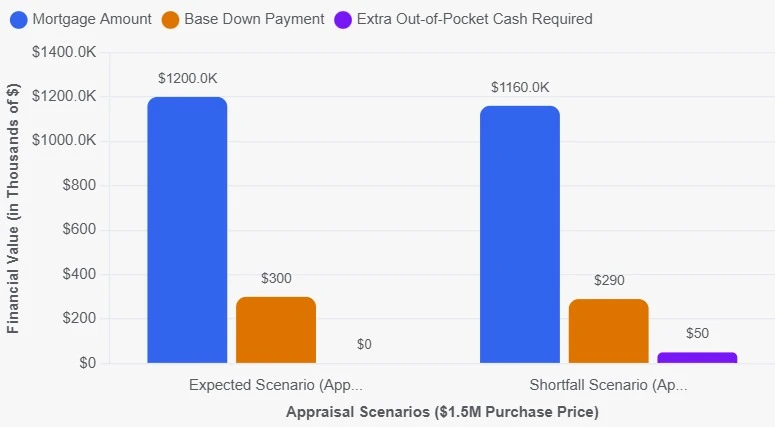
In the chart, the $50,000 bar is the gap between the price and the appraised value. Your total cash goes up by $40,000 compared with the original plan, because the mortgage and the base down payment shift at the same time.
Lenders have different policies, so ask yours how they handle it. If you're in a competitive bidding situation, ask your agent and your mortgage professional how much cash you could cover if the appraisal comes in low.
Mortgage Default Insurance and the Sales Tax on It
If you put down less than 20%, you need mortgage default insurance. The premium is a percentage of the loan and is usually added to your mortgage. Ontario charges a provincial sales tax of 8% on that premium, and this tax is paid in cash at closing. It can't be added to the mortgage.
Here's an example with a $750,000 home and the minimum down payment of $50,000 (5% on the first $500,000 and 10% on the rest). The mortgage is $700,000. If the premium rate at that down payment is 4%, the premium is $28,000, which gets added to the loan. The sales tax is 8% of $28,000, or $2,240, and you pay that in cash on closing day.
Premium rates depend on how much you put down and can change, so ask your lender or broker for the exact figure.
New Build and Pre-Construction Closing Costs in North Oakville
Buying a new home in North Oakville, including areas along Dundas Street West and the Trafalgar Road corridor, adds costs that resale buyers don't see.
HST on New Homes vs. Resale Homes
Resale homes are generally not subject to HST on the price, so the price in your agreement is the price you pay. A new home is different. HST applies to the purchase, and Ontario's rate is 13%. Federal and provincial rebates can offset some or all of it, and builders usually credit the rebate to you on closing day.
These rebates have changed several times, with different rules for first-time buyers, other buyers who will live in the home, and investors. Because the thresholds and dates move, ask your lawyer which programs apply to your agreement. Also check if the price in your contract includes HST, and if the rebate is assigned to the builder. If you're buying as an investment and not to live in, you may have to pay the full HST at closing and apply to recover part of it later.
Charges Builders Add at Closing
Your agreement usually includes a list of adjustments on top of the price. Common ones include:
Development charges and education levies, if they're not already included in the price
The Tarion warranty enrollment fee
Utility connection and meter charges
Deposits for lot grading, fencing, or tree planting
A condo reserve fund contribution and the first month's fees, for condo townhomes and apartments
Each of these can run to a few thousand dollars, and development charges can run higher.
Ask Your Lawyer About Caps
Development charges can go up between signing and closing, and the builder may pass the increase to you. Many new home agreements in Ontario give you a 10-day cooling-off period after signing, and that's the time to have your lawyer review the contract. Ask whether the agreement caps these charges and what the cap is.
Also keep in mind that deposits for a new build are paid in stages, and your lender will want proof of each one. Your cash needs at closing are separate from what you've already paid in deposits.
Condo and POTL Townhome Costs
Condos and freehold townhomes on a shared private road (often called a POTL, or parcel of tied land) bring a few extra items.
Status Certificate
A status certificate is a package from the condo corporation that shows its finances, rules, insurance, and any legal disputes. The cost to order one is set by law and is modest, though rush orders can cost more. Your lawyer reviews it and may charge extra for the time.
Reserve Fund and Special Assessments
A reserve fund pays for large repairs, such as roofs, elevators, or repaving a shared road. Condo corporations in Ontario must have their reserve fund studied regularly. If the fund is low, owners may face higher fees or a one-time special assessment. Reading the status certificate before you remove conditions is how you find this out while you can still walk away.
Common Element Fees on POTL Townhomes
On a POTL townhome, you own the house and the lot, and you also pay a monthly fee for shared items such as the road, snow removal, and landscaping. Ask about the fee and the reserve fund before you make an offer.
Other Costs Around Closing Day
These costs aren't on the lawyer's statement, but they land on the same week.
Cost | What to Know |
|---|---|
Home insurance | Your lender requires proof of coverage before funding, so arrange it ahead of closing |
Movers | Prices depend on distance and volume, so get quotes early |
Locks and security | Re-keying exterior doors is common after any purchase |
Utility and internet setup | Set up accounts in your name for the closing date |
Non-resident speculation tax | A provincial tax can apply to some purchases by foreign nationals and foreign corporations, so check with your lawyer |
Final Thoughts
Closing costs are easier to handle when you know the big items in advance. In Oakville, that means starting with land transfer tax, because it's the largest line and the easiest to calculate. Once you know that number, add the lawyer, title insurance, adjustments, and any mortgage insurance tax, then add a margin for move-in costs.
If you're buying a new build or a condo, add the builder charges, the HST questions, or the status certificate review to that list, and ask your lawyer about them before you sign or remove conditions. A written estimate from your lawyer a few weeks before closing will show you the final figure, and it's better to find out then than on the day.
When you've got a number in mind, share it with your agent and your mortgage professional so the budget for the down payment and the budget for closing costs fit together.
FAQs
How much are closing costs on a house in Oakville?
Many buyers budget somewhere between 2% and 4% of the purchase price. Land transfer tax is the biggest piece, followed by legal fees, title insurance, and adjustments. First-time buyers pay less because of the rebate, and new builds can cost more.
Does Oakville have a municipal land transfer tax?
No. Oakville and Halton Region don't charge a municipal land transfer tax. Buyers pay only the Ontario provincial land transfer tax, which is collected by your lawyer on closing day.
Can you roll closing costs into a mortgage in Ontario?
Generally no. Land transfer tax, legal fees, and adjustments must be paid in cash on closing day. The mortgage insurance premium can be added to the loan, but the provincial sales tax on that premium has to be paid in cash.
Who pays land transfer tax in Ontario, the buyer or the seller?
The buyer pays it. Your lawyer collects the tax on closing day and remits it to the province when the transfer is registered. Sellers don't pay land transfer tax, though they have their own costs such as realtor commission and legal fees.
What is the $4,000 land transfer tax rebate in Ontario?
It's a provincial rebate for eligible first-time buyers. It reduces the land transfer tax by up to $4,000, which covers the full tax on homes priced up to about $368,000. On higher-priced homes, you pay the remaining tax.
How much do real estate lawyers charge in Oakville?
Most charge a flat fee for a standard purchase, and disbursements are billed separately at cost. Fees vary by firm and by the type of property, and condos usually cost more. Ask for a written quote that separates fees, disbursements, and taxes.
Do I pay HST on a resale home?
Generally no. HST is normally charged on new homes, not on resale homes. If you're buying a new build, the HST and any rebates can have a large effect on your closing costs, so ask your lawyer how it applies to your agreement.
What happens if the appraisal is lower than the purchase price?
The lender bases the mortgage on the lower value, so you cover the difference in cash. For example, if you're putting 20% down, a $50,000 shortfall means about $40,000 more cash on closing day. Check your lender's policy early.
Tags
Recent Blogs

Elementary Schools in The Preserve Oakville & Homes Nearby
October 13, 2026
Read More
Living in The Preserve Oakville: Commute, GO & Home Values
October 12, 2026
Read More
Pre-Construction vs. Resale Homes in The Preserve
October 9, 2026
Read More
First-Time Home Buyer's Guide to Preserve Oakville
October 8, 2026
Read More