
Mortgage Pre-Approval in Oakville: A Complete Guide for Home Buyers
October 6, 2026
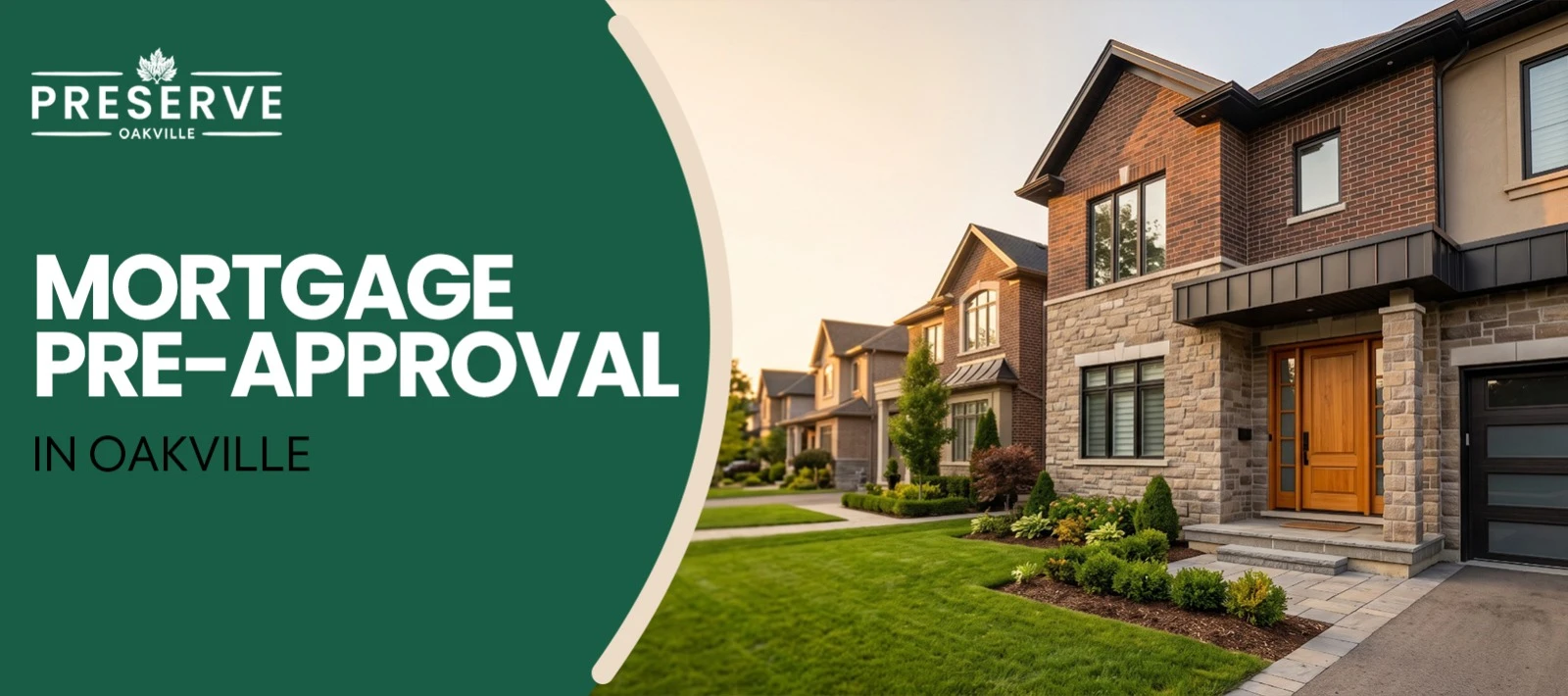
Oakville buyers often shop in price ranges where Canadian mortgage rules change. A home in The Preserve, Glen Abbey, Joshua Creek, or Olde Oakville can sit above the point where the minimum down payment goes up, and some homes sit above the point where mortgage default insurance is no longer available at all. That's why the order of steps matters: sort out your financing first, then book showings.
This guide covers what a pre-approval is, how the stress test works, how much you need down, which documents lenders ask for, and how banks and brokers differ. It also explains how financing works for pre-construction homes in North Oakville and how first-time buyer programs fit in.
A quick note on numbers. Interest rates, program limits, and rebates change over time, so this guide explains how the rules work and points you to the figures to confirm with your lender or broker. Where a dollar amount or percentage appears, treat it as the rule at the time of writing and double-check it before you act on it.
What Is a Mortgage Pre-Approval?
A pre-approval is the lender's way of telling you how much they're prepared to lend before you've found a house. It's based on a review of your income, debts, credit, and savings, and it usually comes with a rate you can count on for a set period.
Mortgage Pre-Approval Definition
A mortgage pre-approval is a lender's written statement of the maximum loan amount a buyer qualifies for, based on a review of their credit, income, debts, and assets. It usually includes an interest rate that the lender holds for a limited time, commonly 90 to 120 days.
What Is a Rate Hold?
A rate hold is a lender's commitment to keep a specific interest rate available to you for a set window, usually around 120 days. If market rates rise while you shop, you can still use the held rate. If they fall, many lenders will give you the lower rate at closing.
Pre-Approval vs. Pre-Qualification
The two terms sound similar, but sellers and agents treat them very differently.
Pre-Qualification | Pre-Approval | |
|---|---|---|
How it's done | Quick estimate from numbers you provide | Lender reviews documents and pulls your credit |
Rate hold | No | Usually yes |
Weight with sellers | Light | Much stronger |
Best used for | Early budget thinking | Active house hunting |
Why Pre-Approval Comes Before the House Search in Oakville
Many Oakville listings draw interest quickly, and an offer with a clear financing plan looks better to a seller than one without it. A pre-approval also tells you which homes are realistic before you fall for one that isn't.
It Sets a Budget Based on Your File
Online calculators give you a rough idea. A lender gives you a number based on your actual income, debts, and credit. That's the figure you can shop with.
It Protects You From Rising Rates
Rates move with bond markets and Bank of Canada decisions. A rate hold gives you a ceiling while you look. Ask the lender what happens if rates fall, because most will let you take the lower rate, but policies differ.
It Strengthens Your Offer
When a seller reads your offer, they want to know it can close. A pre-approval letter doesn't remove all risk, but it shows that a lender has already looked at your finances.
How the Mortgage Stress Test Works
Federally regulated lenders must check that you can still afford your mortgage if rates go up. This check, called the stress test, often decides how much you can borrow. Lenders that aren't federally regulated may have their own rules, and your broker can explain where that applies.
What Is the Minimum Qualifying Rate?
The Minimum Qualifying Rate (MQR) is the federally set interest rate a buyer must qualify at under the Canadian mortgage stress test. It is the higher of the contract rate plus 2 percentage points, or a benchmark floor that has been 5.25% for some time.
Here's a simple example. If your contract rate is 4.35%, the lender checks your payments at 6.35%. You pay the lower rate, but you must show you could handle the higher one. The effect is that your maximum mortgage ends up noticeably lower than what a simple calculator at the contract rate would suggest.
Some borrowers with 20% or more down can switch lenders at renewal without taking the test again, as long as the loan amount and amortization stay the same. Ask your broker whether that applies to you when the time comes.
How GDS and TDS Ratios Work
Lenders use two ratios to measure your ability to carry a mortgage. Both compare your monthly obligations to your gross (before-tax) income.
Ratio | What It Measures | Typical Limit for Standard Files |
|---|---|---|
Gross Debt Service (GDS) | Mortgage payment, property tax, heating, and half of condo fees | About 39% of gross income |
Total Debt Service (TDS) | Everything in GDS plus car loans, student loans, credit cards, and lines of credit | About 44% of gross income |
Those limits apply to many standard and insured files. Some alternative lenders will go higher when other parts of the file are strong, such as a high credit score or large savings, so the exact limit depends on the lender.
Down Payment Requirements for Oakville Homes
Canada uses a tiered system. The minimum depends on the purchase price, and it climbs as the price rises. The thresholds have changed in the past, so confirm the current ones before you plan around them.
The Tiered Down Payment Rule
Under the rule at the time of writing, the minimum is 5% on the first $500,000 of the price, 10% on the portion between $500,000 and $1.5 million, and a flat 20% once the price reaches $1.5 million. Mortgages with less than 20% down need mortgage default insurance, and homes at the top tier can't be insured.
Purchase Price | Minimum Down Payment | Insurance |
|---|---|---|
$500,000 | $25,000 | Required |
$800,000 | $55,000 | Required |
$1,000,000 | $75,000 | Required |
$1,500,000 | $300,000 | Not available (20% down) |
The amounts above use the tier rule as an example. Your lender can calculate the exact figure for your price and confirm whether the thresholds have changed.
The insurance premium, if you need it, is usually added to your mortgage balance, so it affects your monthly payment. Providers include CMHC, Sagen, and Canada Guaranty.
Gifted Down Payments
Most lenders accept a down payment gift from close family, such as parents, grandparents, or siblings. A gift from a friend or distant relative is often refused. The money has to be a true gift with no expectation of repayment. If it's a loan, the lender treats it as debt.
Expect to provide a signed gift letter from both you and the donor, a bank statement showing the donor had the funds, and proof that the money landed in your account. Lenders usually want that transfer completed well before closing, so don't leave it until the last week.
Borrowed Down Payments
Some programs allow a down payment that comes from borrowed money, such as a personal loan or line of credit. It's more complicated. The lender adds the payments on that loan to your debt load, which lowers the mortgage you can qualify for. Lenders also tend to look for stronger credit and stable employment, and they may want separate savings to cover closing costs. A broker can tell you which lenders allow this and what it costs.
Documents You Need for a Pre-Approval
Complete paperwork speeds up a pre-approval. Missing or unclear documents are one of the most common causes of delay.
For Employed Buyers
Government-issued photo ID
Two years of T4 slips and Notices of Assessment from the Canada Revenue Agency
A recent employment letter showing your position, start date, and salary
Recent pay stubs showing year-to-date earnings
A signed consent for the lender to check your credit
For Down Payment and Assets
About 90 days of statements for every account holding your down payment (chequing, savings, TFSA, RRSP, or FHSA)
A gift letter and transfer records if a family member is helping
Details of existing debts, such as car loans, student loans, and credit cards
Statements for any property you already own
Lenders look for steady savings over time. Large deposits you can't explain tend to raise questions, so keep records of where the money came from. Canadian anti-money-laundering rules (FINTRAC) also require lenders, brokers, and lawyers to verify your identity and the source of your funds, which is one reason the paper trail matters.
For Self-Employed Buyers
Self-employed buyers usually need to prove income over a longer period because it varies. Most prime lenders ask for two years of personal tax returns with Notices of Assessment. If you have a corporation, they'll often also ask for two years of financial statements and incorporation documents.
Lenders typically average your income across the two years, often using the total income figure on Line 15000 of your tax return. If your income dropped in the more recent year, many will use the lower figure instead. Business write-offs that reduce your taxable income also reduce the income a lender can count.
If your tax return understates your real earnings, a broker may be able to place you with an alternative lender that looks at business bank statements over six to twelve months. These lenders usually charge higher rates and sometimes a fee, so it's worth comparing the cost against the benefit.
How to Get Pre-Approved, Step by Step
Step 1: Check Your Credit
Pull your own credit reports from Equifax and TransUnion and look for errors. Fixing a wrong late payment or a closed account that still shows a balance can help your score before anyone runs a formal check.
Step 2: Gather Your Documents
Use the lists above. Having everything in one folder saves time when the lender or broker asks for it.
Step 3: Choose Where to Apply
You can apply at a bank, a credit union, or through a mortgage broker. The next section compares them. It's reasonable to speak with at least two before deciding.
Step 4: Review the Pre-Approval Letter
Look past the maximum amount. Check the interest rate, how long it's held, the mortgage type, the amortization, and what conditions apply. Ask what could cause the approval to change before closing.
Step 5: Share the Result With Your Agent
Give your real estate agent your approved range, but also tell them your comfortable monthly payment. The maximum you qualify for and the amount you want to spend are often different numbers. Property tax, insurance, utilities, and maintenance all sit on top of the mortgage payment.
How Long Does a Pre-Approval Last?
Most pre-approvals last around 90 to 120 days, with some lenders offering 60 days or a bit longer. Check your letter for the exact period.
If Rates Go Up
Your held rate stays available as long as you find a property and complete the purchase within the hold period. This is the main benefit of the hold.
If Rates Go Down
Many lenders will adjust your rate to the lower market rate at closing, though it depends on the lender and the product. Ask for this in writing if it matters to you.
If the Pre-Approval Expires
You can usually ask the lender or broker to renew it. They may request updated documents and check your credit again, and the rate may differ from the original.
Credit Scores and Pre-Approval
Your credit score affects which lenders will work with you and what rate they offer. There's no single cutoff that applies everywhere, but these ranges are a common guide.
Typical Credit Ranges by Lender Type
Lender Type | Typical Score Range | What to Expect |
|---|---|---|
A-lenders (major banks and prime monoline lenders) | About 680 and up | Best available rates, most standard approvals |
B-lenders (credit unions and trust companies) | Roughly 550 to 670 | Higher rates, more weight on income and property equity |
Private lenders | Often no set minimum | Highest rates and fees, based mostly on property equity |
Scores of 720 or higher tend to make approval smoother with prime lenders.
Ways to Raise Your Score Before You Apply
Pay down credit card balances so they're under about 30% of each limit
Pay before the statement closing date, since that's often the balance reported to the bureaus
Ask for a credit limit increase if the issuer can do it without a hard inquiry
Dispute errors on your credit reports
Hold off on new loans, store cards, and car financing for several months before applying
Credit repair takes time, so start early if your score is close to a lender tier.
Bank or Mortgage Broker?
Both can get you a pre-approval. The right choice depends on your situation, and many buyers compare both.
Banks
A bank can keep your mortgage, chequing, savings, and investments in one place, and a relationship manager may offer discounts if you bring other business. The downside is that a bank sells only its own products and usually has stricter rules for self-employed buyers or files that don't fit the standard mold.
Mortgage Brokers
A broker applies on your behalf to many lenders, including banks, credit unions, and monoline lenders. That helps if your income is unusual, if you want to compare several offers, or if you simply want someone else to do the shopping. Brokers can't offer the in-branch experience, and some of the lenders they use aren't household names.
Monoline Lenders and Break Penalties
A monoline lender offers mortgages only. No chequing accounts or credit cards. Many sell through brokers and tend to have competitive rates and flexible terms.
The bigger difference shows up if you need to break a fixed-rate mortgage early. Lenders charge the greater of three months of interest or an interest rate differential (IRD) amount. Some large banks calculate the IRD using their posted rates, which can be higher than the rate you actually received. This can make their penalties much larger than those from lenders that use your real contract rate. Always ask how a lender calculates the penalty before you sign, and ask for an example with your own numbers.
How Brokers Get Paid
For most standard mortgages, a broker doesn't charge you a fee. The lender pays the broker a commission when the mortgage funds. If your file needs an alternative or private lender, the broker may charge a fee, which should be disclosed up front.
Financing Pre-Construction vs. Resale Homes in North Oakville
Communities like The Preserve and the areas along Dundas Street West and the Trafalgar Road corridor include both resale homes and new builds, and the Halton Region housing market has plenty of each. Buyers who care about commuting often compare these areas by distance to the Oakville GO Station and the highways. The way financing works for a new build is different from a resale purchase, so it's worth understanding both.
Resale Homes
With a resale home, you get pre-approved, make an offer, and the lender reviews the property. Closing is usually somewhere between 30 and 90 days after the offer is accepted, with your rate already held.
Pre-Construction Homes
With a pre-construction home, final closing can be a year or more after you sign. A standard rate hold won't cover that gap, so you need to think about how your mortgage will be set up.
Deposits are usually paid in stages rather than all at once. Many Greater Toronto Area builders ask for a total in the range of 15% to 20% across several dates.
Lenders count those deposits toward your down payment, but they'll ask for proof of each payment.
Some projects include an interim occupancy period. You move in before the title transfers, and you pay the builder monthly occupancy fees instead of mortgage payments.
Your mortgage usually starts at final closing, and you generally have to qualify under the rules and rates in place then, not the ones in effect when you signed.
Some lenders offer extended rate holds for new builds, which can run well beyond the usual period. These can carry a premium, so ask what it costs and what happens if the closing date moves. Most lenders will also re-check your income and debts shortly before closing. If your job, debts, or credit change in the meantime, your approval can be affected.
New builds also come with closing items that resale buyers don't see, such as development levies and other charges listed in the Statement of Adjustments from the builder. Ask whether any of these are capped in your agreement, and budget for them in addition to your down payment.
Deposit protection for new homes in Ontario has limits. Ask your real estate lawyer how much of your deposit is covered for the specific project, especially if the total deposit is large.
First-Time Buyer Programs: FHSA, HBP, and Land Transfer Tax Rebate
First-time buyers can use more than one program at the same time. Each has its own rules and limits, and the numbers are updated from time to time, so check the Canada Revenue Agency website before you rely on them.
Using the FHSA and the Home Buyers' Plan Together
The First Home Savings Account (FHSA) lets you save for a first home with tax-free growth, and withdrawals for a qualifying home purchase are tax-free. The Home Buyers' Plan (HBP) lets you take money out of your RRSP for a first home, and you repay it to your RRSP over a set number of years.
You can generally use both for the same purchase. At the time of writing, the FHSA allows up to $40,000 in lifetime contributions and the HBP allows up to $60,000 per person, so one buyer can draw on up to $100,000 and a couple on up to $200,000. These limits have been raised before, so confirm them on the Canada Revenue Agency website. A few points to plan around:
RRSP money intended for the HBP generally has to stay in the account for at least 90 days before you withdraw it. The FHSA has no 90-day holding rule for withdrawals.
Lenders want to see statements for both accounts as part of the down payment verification
Withdrawals require specific CRA forms (the T1036 for the HBP and the RC720 for the FHSA), and your lender or lawyer can tell you the timing that works for your closing date
HBP withdrawals are repaid to your RRSP over 15 years, and if you miss a yearly repayment, that amount is added to your income for the year
Repayment normally starts in the second year after the withdrawal, but the government has temporarily extended that grace period to five years for some withdrawal dates, so check which one applies to your purchase year
Land Transfer Tax Rebates
Ontario charges a provincial land transfer tax when you close, and first-time buyers can claim a rebate that reduces it. For many Oakville purchases, the rebate won't cover the full amount, so you'll still owe the rest at closing.
The City of Toronto charges its own municipal land transfer tax, but Oakville and the rest of Halton Region don't. That means Oakville buyers deal with the provincial tax only. Your lawyer will calculate the exact amount on closing.
Closing Costs to Budget For
Many buyers focus on the down payment and forget that closing costs need cash too. Lenders may ask you to show you have funds set aside for them, sometimes around 1.5% of the purchase price.
Cost | What to Know |
|---|---|
Land transfer tax | Paid at closing, reduced by the first-time buyer rebate if you qualify |
Legal fees | Your lawyer handles title, funds, and registration |
Home inspection | Usually a few hundred dollars, paid before you waive conditions |
Appraisal | Sometimes required by the lender, and sometimes covered by them |
Title insurance | Often arranged through your lawyer |
Adjustments | Prepaid property taxes and utilities that the seller has already paid |
Mortgage insurance premium | Only for down payments under 20%, usually added to the mortgage |
What to Avoid After You're Pre-Approved
A pre-approval is based on your finances on the day you apply. Lenders usually check again before closing, so changes between now and then can cause problems.
Don't take on new credit cards, loans, or car leases
Don't change jobs or income structure without talking to your lender or broker first
Don't move large sums between accounts without a record
Don't miss payments on existing debts
Don't buy furniture or appliances on credit before the closing date
Final Thoughts
A pre-approval won't pick the right home for you, but it removes a lot of guesswork. You'll know what you can borrow, what you need to have saved, and how long your rate is protected. In an area like Oakville, where many homes sit near a down payment threshold, that knowledge can change the price range you look at.
Start with your documents and credit, then speak with a broker and a bank so you can compare. Pay attention to the details of the letter, not only the amount. If you're thinking about a new build in North Oakville, ask early how the rate hold, deposits, and final qualification will work, because those differ from a resale purchase.
When you're ready to look at homes, talk with a local agent who can match the neighbourhoods and property types to your approved range.
FAQs
How long does a mortgage pre-approval last in Ontario?
Most last about 90 to 120 days, though some lenders offer 60 days or slightly longer. During that time your rate is held. Check the letter for the exact period, and ask about renewal if your search takes longer.
What documents do I need for a mortgage pre-approval in Canada?
Expect to provide photo ID, two years of T4 slips and Notices of Assessment, an employment letter, recent pay stubs, and about 90 days of statements for accounts holding your down payment. Self-employed buyers usually add tax returns and, for corporations, financial statements.
Does a pre-approval protect me if interest rates rise?
Yes, for the length of the rate hold. If rates climb while you're shopping, you can usually still use the held rate, as long as you buy within the hold period. Many lenders will also give you a lower rate if the market falls.
Can I be denied a mortgage after getting a pre-approval?
Yes. A pre-approval is not a final commitment. The lender still has to approve the property, and they usually recheck your finances before closing. A new debt, a job change, a drop in income, or an appraisal below the purchase price can lead to a different outcome.
What credit score do I need for a pre-approval in Ontario?
Major banks and prime lenders generally prefer a score of about 680 or higher, and scores above 720 tend to make approval easier. Alternative lenders may work with lower scores at higher rates. Lender requirements vary, so ask what applies to your situation.
Does getting pre-approved hurt my credit score?
A pre-approval usually involves a credit check, which can lower your score by a small amount for a short time. Several mortgage inquiries in a short period are often treated as one, but ask your lender or broker how they handle it.
How much does a mortgage pre-approval cost?
Most banks and brokers offer pre-approvals at no charge. If someone asks for a fee, ask what it covers and compare it against other options.
What is the minimum down payment for a $1.5 million home in Canada?
Under the rules at the time of writing, homes priced at $1.5 million or more need at least 20% down, which would be $300,000 on a $1.5 million purchase. Mortgage default insurance isn't available at that price. Check current thresholds with your lender before you plan.
Can I use both the FHSA and the Home Buyers' Plan for the same purchase?
In most cases, yes. First-time buyers can usually withdraw from both for the same home, and couples can combine their amounts. Each program has its own limits, forms, and timing rules, so confirm the details with the CRA and your lender.
Is a mortgage broker better than a bank?
Neither is better in every case. A broker can compare many lenders and often helps most when your income is unusual, while a bank can be convenient if you already hold your accounts there. Many buyers get a quote from both before choosing.
Tags
Recent Blogs

Elementary Schools in The Preserve Oakville & Homes Nearby
October 13, 2026
Read More
Living in The Preserve Oakville: Commute, GO & Home Values
October 12, 2026
Read More

Pre-Construction vs. Resale Homes in The Preserve
October 9, 2026
Read More
First-Time Home Buyer's Guide to Preserve Oakville
October 8, 2026
Read More