
Home Insurance in The Preserve Oakville: What Buyers Should Know in 2027
November 24, 2026
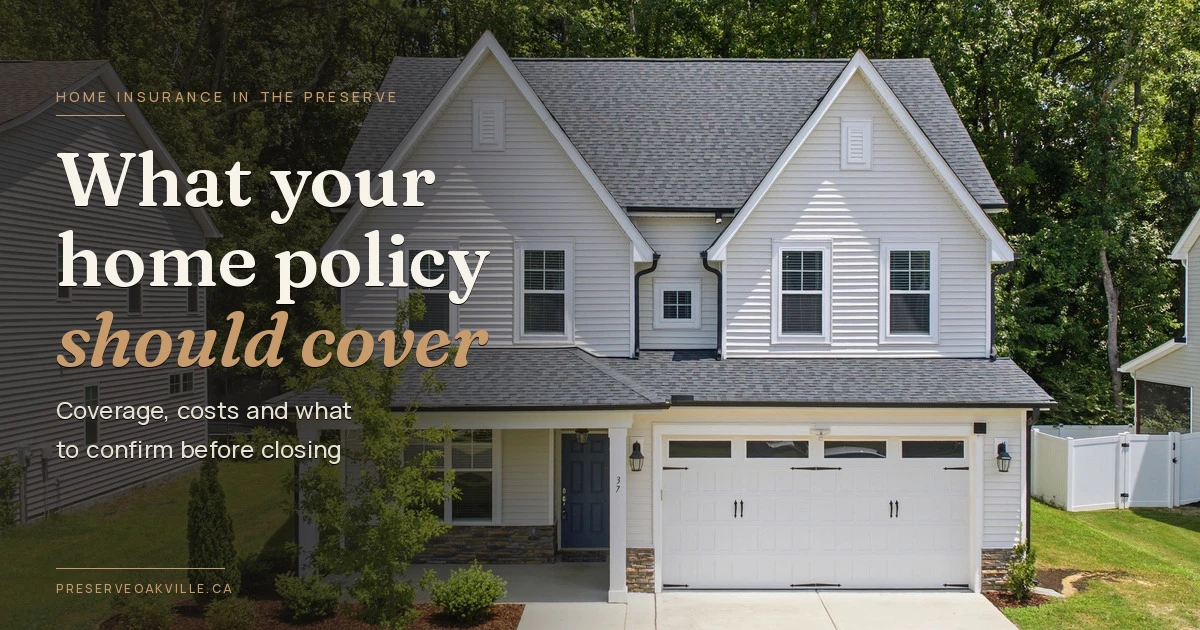
The offer on a townhouse in The Preserve has gone firm, the lawyer has sent a list of items needed before closing, and one line on it reads “binder or proof of insurance.” For many buyers, that is the moment home insurance in The Preserve Oakville stops being an abstract idea and becomes a deadline. A policy has to be in place for the lender to release the mortgage funds, and the choices made in a few rushed days can decide what a household is actually protected against for years.
What follows is a calm reading of how home insurance in Ontario works for a house, a townhouse or a condominium unit in The Preserve, using the plain-language guidance published by the Insurance Bureau of Canada (IBC), the questions recommended by the Financial Services Regulatory Authority of Ontario (FSRA), and the warranty rules set by Tarion for newer homes. It explains what shapes the price, without inventing a typical premium, and it lists the points a buyer should confirm in writing before closing in 2027 or any other year.
What Home Insurance in The Preserve Oakville Does and Does Not Cover
Before comparing quotes, it helps to know what a standard policy is built to do. IBC describes home insurance as a policy for sudden and accidental loss, not a maintenance plan. A peril, in insurance terms, is a chance event that is unexpected and accidental from the policyholder’s point of view.
Usually covered | Usually not covered |
|---|---|
Fire, lightning and explosion | Gradual deterioration, such as a worn-out roof |
Theft and vandalism (where the building is normally occupied) | Preventable losses, such as indoor pipes that freeze when the heat was off |
Wind and hail damage to the exterior | Earth movement and earthquakes, unless added |
Sudden and accidental escape of water from plumbing, heating or appliances | Sewer backup and overland flood, unless added as optional coverage |
Window breakage in a normally occupied building | Damage by insects and rodents |
The practical lesson is that the quote in your hand is only as good as its exclusions and optional add-ons. Those are the lines worth reading first.
The Short Version
Is it required? Home insurance is not required by law, but IBC notes that most lenders will require a buyer to purchase coverage, name the lender on the policy and provide proof before advancing a mortgage.
Four levels of coverage: IBC describes comprehensive, broad, basic or named perils, and no frills. The level matters more than the brand name on the policy.
Building limit: it should reflect what it would cost to rebuild the home. IBC says replacement value may differ from both the market value and the municipal assessment value.
What sets the rate: IBC lists seven factors: replacement cost, how well the home is maintained and updated, wood stoves and fireplaces, unique features and uses, location, distance from a fire hydrant and fire station, and the owner’s claims history.
Water coverage: sewer backup and overland flood are typically optional, not standard. That topic gets its own section below.
Tarion is not insurance: a Tarion warranty on a newer home covers certain defects for set periods from possession, while insurance covers sudden and accidental loss, liability and contents.
No average premium: IBC does not publish an average premium for The Preserve. Quotes depend on the property, the coverage chosen and the insurer.
Home Insurance in The Preserve Oakville: How It Works
A homeowner’s policy has two broad halves. IBC describes them as personal property coverage and personal liability coverage. The first pays to repair or rebuild the dwelling and replace belongings after an insured loss. The second responds when someone else is injured, or their property is damaged, and the policyholder is held legally responsible.
The Four Levels of Coverage
IBC’s description of the types of home insurance coverage sets out four levels, and the differences between them are worth reading slowly.
Level | What IBC says it does | What a buyer should ask |
|---|---|---|
Comprehensive | Covers the building and contents for all risks except those specifically excluded | Which exclusions apply, and which optional coverages are available separately |
Broad | Comprehensive coverage on big-ticket items such as the building, and named-perils coverage on contents | Which perils are named for contents |
Basic or named perils | Covers only the perils specifically stated | Whether common risks such as water escape are on the list |
No frills | Offered by some insurers for properties that do not meet normal insurance standards | What would need fixing to qualify for better coverage |
The point of the table is not to choose a level from a blog post. It is to make sure each quote says which level it is, so that two quotes can be compared on equal terms.
Personal Liability
IBC explains that liability coverage applies to bodily injury or property damage unintentionally caused to others, up to the policy limit, and that if a policyholder is sued for something covered, the insurer pays the legal costs. Injuries to the policyholder or members of the household are not covered, and the coverage follows the policyholder’s actions anywhere in the world, not only on the property.
For a household in a neighbourhood of front porches, shared walkways and winter sidewalks, the classic example IBC uses is apt: a visitor who slips on a snow-covered walkway. The liability limit is a number on the declarations page. It is worth asking what it is, and what a higher limit would cost.
Additional Living Expenses
If a home becomes unliveable after an insured loss, most policies cover alternate accommodation and living expenses. IBC suggests asking the insurer which claims fall under additional living expenses. For a family with children in a local school, the limit and the duration are practical questions, not fine print.
What Shapes Home Insurance Costs in The Preserve
Buyers comparing homeowners insurance in Oakville often search for a number. The more useful question is what moves the number. IBC names seven factors and notes that every insurer weighs risk differently.
Replacement Cost, Not Purchase Price
IBC says a home’s size, how and where it is built, and the value of the contents significantly affect what a household pays. To estimate a replacement value, the insurance representative will want basic information: the home’s age, its size and number of storeys, the type of construction, roofing and heating, the number of fireplaces or wood stoves, and any unique features such as a swimming pool.
This is one place where The Preserve’s price levels can mislead. A purchase price includes the land under the house. IBC’s tips on how to drive down home insurance rates advise against over-insuring by including the market price of the land, and suggest insuring the home for what it would cost to rebuild with like-quality materials. The opposite error is just as real: an outdated or low building limit can leave a shortfall after a major loss. Neither the sale price nor the assessed value is a substitute for a proper rebuilding estimate, and the MPAC assessment and property tax in Oakville serve a different purpose entirely.
Condition and Updates
IBC lists electrical, plumbing and roofing among the items insurers ask about. Its examples include knob-and-tube or aluminum wiring, fuses or service under 100 amps, and galvanized steel or lead pipes. Those items are worth asking about on any home, whatever its age, and the roof question applies everywhere. IBC says insurers generally prefer roofs updated within 20 years, and notes that if a worn-out roof leaks, the interior damage may be covered but the roof itself would not be. Home insurance, as IBC puts it, is not a maintenance policy.
Wood stoves and fireplaces are a separate factor. IBC advises talking to your insurer before buying or renting a property with a wood stove, because the insurer may require an inspection and wood-burning appliances can affect the availability and affordability of coverage.
For a resale home in The Preserve, that makes the age of the roof, furnace, water heater and any finished basement a reasonable request to the seller and a useful line in the home inspection.
Unique Features and Uses
IBC lists the features and uses an insurer will want to know about:
a home-based business
renting out all or part of the property
a designated heritage property
burglar, smoke and carbon monoxide alarms, and whether they are monitored off site
a swimming pool
additional structures such as a pool house, a separate garage or a home office shed
Two of these come up often in The Preserve. The first is a rented basement or a second unit. The second is a backyard pool or hot tub. Both should be disclosed before the policy is bound, not after.
Location, Fire Protection and Claims History
IBC explains that insurers track the number, type and cost of claims by neighbourhood, and that areas with more severe weather claims can see insurance costs rise. It also notes that a property far from a fire hydrant or fire station may cost more to insure, and that a personal claims history can affect the premium because past claims are often an insurer’s best predictor of future claims.
A buyer cannot change the neighbourhood or a past claim. What can be done is to ask each insurer which of these factors is driving the quote, and whether any discount is available for protective devices.
Why This Article Quotes No Average Premium
Several insurer and broker pages publish estimated ranges for Oakville home insurance. IBC does not publish an average premium for The Preserve, and private estimates mix very different homes, coverage levels and deductibles. A quoted range for “Oakville” says little about a specific freehold townhouse with a finished basement, a detached house with a pool, or a condominium unit. The only reliable figure is a written quote for the actual property and the actual coverage.
Coverage Points Specific to Preserve Homes
Depending on the listing, a buyer in The Preserve may be looking at a detached house, a townhouse or a home that is part of a condominium corporation. Each raises a few insurance questions that are worth naming.
Newer Homes and the Tarion Warranty
A newer home may still be inside its statutory warranty. Tarion explains that the one-year, two-year and seven-year warranty coverage begins on the date of possession, applies even if the home is sold, and covers defects in work and materials, water penetration and certain system defects in year two, and major structural defects for seven years. A buyer of a home under seven years old that is enrolled with Tarion inherits the balance of the coverage. Work-and-materials coverage limits depend on when the original purchase agreement was signed, and Tarion cites a maximum of $400,000 for recent projects.
That is defect coverage, not insurance. When buyers ask about insurance for new homes, this is the distinction that matters most. A burst supply line after a hard freeze, a kitchen fire or a theft is an insurance matter. A builder defect that causes water to come through a foundation wall in the second year may be a warranty matter. Sometimes both are involved, and the documents decide which applies.
Warranty claims also run on a clock. Tarion uses separate forms with set windows: a 30-day form after possession, a year-end form near the end of year one, and a second-year form during year two. A buyer of a newer resale home should ask the seller for the original possession date, because that date sets every warranty deadline, including the ones that matter if a defect turns up and you need to handle Tarion warranty and new home deficiencies in The Preserve.
Water, Sewer Backup and Overland Flood
Water is the coverage area most likely to surprise a new owner. IBC states that damage from the backing up of sewers and drains is typically not covered by a standard policy, and that sewer backup and overland flood coverage can be added as optional coverage, depending on the insurer and the risk. Because the details vary by insurer, ask each one how water damage, sewer backup and overland flood insurance is offered, and what the limit and deductible would be. For a lot beside a creek corridor or natural area, the planning side of that picture matters just as much when buying beside conservation land in The Preserve.
Condominium Units
Where a home is part of a condominium corporation, two policies are involved. IBC explains that the corporation’s policy typically covers the buildings on the condominium plan, common property and standard fixtures, but does not cover an owner’s personal contents, improvements to the unit or personal liability. A unit owner’s policy typically fills those gaps and can include loss assessment coverage, which pays the owner’s share, up to a stated limit, of certain losses that exceed the corporation’s coverage. Because common-element costs and condo and POTL fees in The Preserve Oakville are tied to what the corporation insures, a buyer should read the status certificate and the corporation’s insurance summary before choosing unit-owner limits.
Rental Units and Home Businesses
IBC’s guidance asks owners to contact their insurance representative before they renovate, install a pool or spa, set up a home-based business such as a daycare, or rent all or part of the property, and warns that failing to tell the insurer before renting can void coverage. A legal second unit or a rented room changes the risk. So does a home office with clients visiting. Telling the insurer is part of keeping the coverage valid. Before insuring a rented space, it also helps to understand the landlord obligations that come with renting out a home in The Preserve Oakville and what a legal unit involves when planning secondary suites and home additions in The Preserve.
A Gap Between Closing and Move-In
Some buyers close weeks before they move in, especially when a renovation comes first. IBC notes that if a home is left for more than four days during the normal heating season, the plumbing should be drained or the home checked regularly to make sure heat is maintained, and freezing damage without those precautions would likely be excluded. Ask the insurer what applies to an unoccupied home, and whether renovation work changes anything, before the keys change hands.
Ways to Manage the Premium
The FSRA and IBC lists overlap, and together they point to a short set of reasonable steps.
Shop around and compare quotes on the same coverage level, limits and deductibles.
Ask about bundling home and auto insurance.
Consider a higher deductible, but only one the household could comfortably pay after a loss.
Ask about discounts for alarm systems, a sewer backwater valve, sump pumps and other loss-prevention devices.
Ask whether being claims-free, mortgage-free, 55 or older or a non-smoker qualifies for a discount.
Consider paying annually to avoid possible instalment charges.
Review the policy every year, especially after renovations or major purchases.
Wait until renewal to switch insurers, to avoid a possible mid-term cancellation penalty.
None of these steps should come at the cost of a building limit that cannot rebuild the house.
A Working Sequence for Buyers
Start asking for quotes as soon as the offer is firm. The lawyer will need proof of coverage before closing.
Gather the facts an insurer will ask for: the home’s age, square footage, number of storeys, construction, roof, heating, fireplaces, finished basement, pool or hot tub, and any outbuildings.
Ask the seller, or the builder on a new home, for the original possession date, the roof age and any upgrades.
Use the FSRA list of questions to ask an agent or broker, including whether the policy pays replacement cost or actual cash value, and when coverage begins.
Compare at least two quotes side by side, line by line: coverage level, dwelling limit, contents limit, liability limit, deductibles, and optional water coverages.
Disclose any rental unit, home business, pool or vacancy period before the policy is bound.
Confirm the lender is named correctly on the policy and send the binder or proof of insurance to the lawyer.
After moving in, create a home inventory with photographs and receipts, and store a copy outside the house.
Review the policy at each renewal and after any renovation.
Points Worth Double-Checking
The effective date. The policy should start on or before the closing date, not on the moving day.
Replacement cost versus actual cash value. FSRA lists this among the first questions to ask. The answer shapes every claim.
Special limits on valuables. IBC notes that items such as fine art, jewellery and collections are subject to specific limits. Ask whether appraisals are required to insure them fully.
Sheds, detached garages and storage. IBC notes that a home policy covers outbuildings such as a shed or detached garage with some limitations. Ask about the limit, and whether a locker or storage unit is covered.
Optional water coverage limits. If sewer backup or overland flood coverage is added, confirm the limit and the deductible, which may differ from the main policy.
The condominium deductible. In a condominium, ask the corporation how its insurance deductible is handled under its declaration and by-laws, and ask the insurer whether the unit policy would respond to that cost.
Reporting duties. IBC says policyholders must promptly tell their insurer about changes in circumstances. A new suite, a pool or a business can all count.
How a dispute is handled. Start with the representative or adjuster, then the insurer’s complaint process or ombudsperson. If the matter is still unresolved, the General Insurance OmbudService (1-877-225-0446) handles home insurance disputes, and in Ontario, insurance is regulated by FSRA. IBC’s Consumer Information Centre can answer general questions at 1-844-227-5422.
Final Thoughts
Home insurance in The Preserve Oakville does not need to be complicated, but it does need to be deliberate. Start early, describe the home accurately, compare quotes on identical terms, and treat the building limit, the water coverages and the liability limit as the three numbers that matter most. A newer home’s Tarion warranty is useful, and it is not a substitute for a policy. The closing checklist from the lawyer, which also covers Oakville property transfer and closing costs, is easier to finish when the insurance is settled first.
FAQs
Is home insurance mandatory when buying in The Preserve Oakville?
Home insurance is not required by law in Ontario, but the Insurance Bureau of Canada notes that most banks and mortgage lenders require buyers to purchase coverage, name the lender on the policy and provide proof of insurance before they lend. In practice, a buyer with a mortgage will need a policy in place by closing.
How much does home insurance cost in The Preserve?
IBC does not publish an average premium for The Preserve. It says rates depend on the replacement cost, the home’s condition and updates, unique features and uses, location, distance to fire protection and the owner’s claims history. The only reliable figure is a written quote for the specific home and coverage.
Should I insure my home for the purchase price?
Not necessarily. IBC says the building amount should reflect what it would cost to rebuild the home, and that replacement value can differ from market value and the municipal assessment. It also advises against including the market price of the land. Ask the insurer how the rebuilding estimate was calculated.
Does a Tarion warranty replace home insurance on a newer home?
No. Tarion’s one-year, two-year and seven-year coverage applies to certain construction defects for set periods from the date of possession. Home insurance covers sudden and accidental losses such as fire or theft, personal liability and contents. A newer home in The Preserve usually needs both, and the documents decide which one applies to a particular problem.
Do I need to tell my insurer about a basement rental or home business?
Yes. IBC advises contacting the insurance representative before renting all or part of a property, setting up a home-based business such as a daycare, renovating, or installing a pool or spa. These changes affect the risk, and failing to disclose them can create problems with coverage.
What can I do if my insurer denies a claim?
Start by asking the representative or adjuster for an explanation, then use the insurer’s complaint process or ombudsperson and ask for a final position letter. If the matter is still unresolved, you can contact the General Insurance OmbudService, which handles home insurance disputes, or file a complaint with FSRA, Ontario’s insurance regulator.
Tags
Recent Blogs

Home Maintenance Checklist For 10-Year-Old Homes In The Preserve Oakville
November 20, 2026
Read More
Construction Near Homes In North Oakville: Noise, Dust And What Preserve Buyers Should Check
November 18, 2026
Read More
Subdivision Assumption in Oakville: What Preserve Homeowners Should Know in 2027
November 24, 2026
Read More
Stormwater Ponds in The Preserve Oakville: What Buyers Should Know in 2027
November 24, 2026
Read More