
First-Time Home Buyer's Guide to Preserve Oakville
October 8, 2026
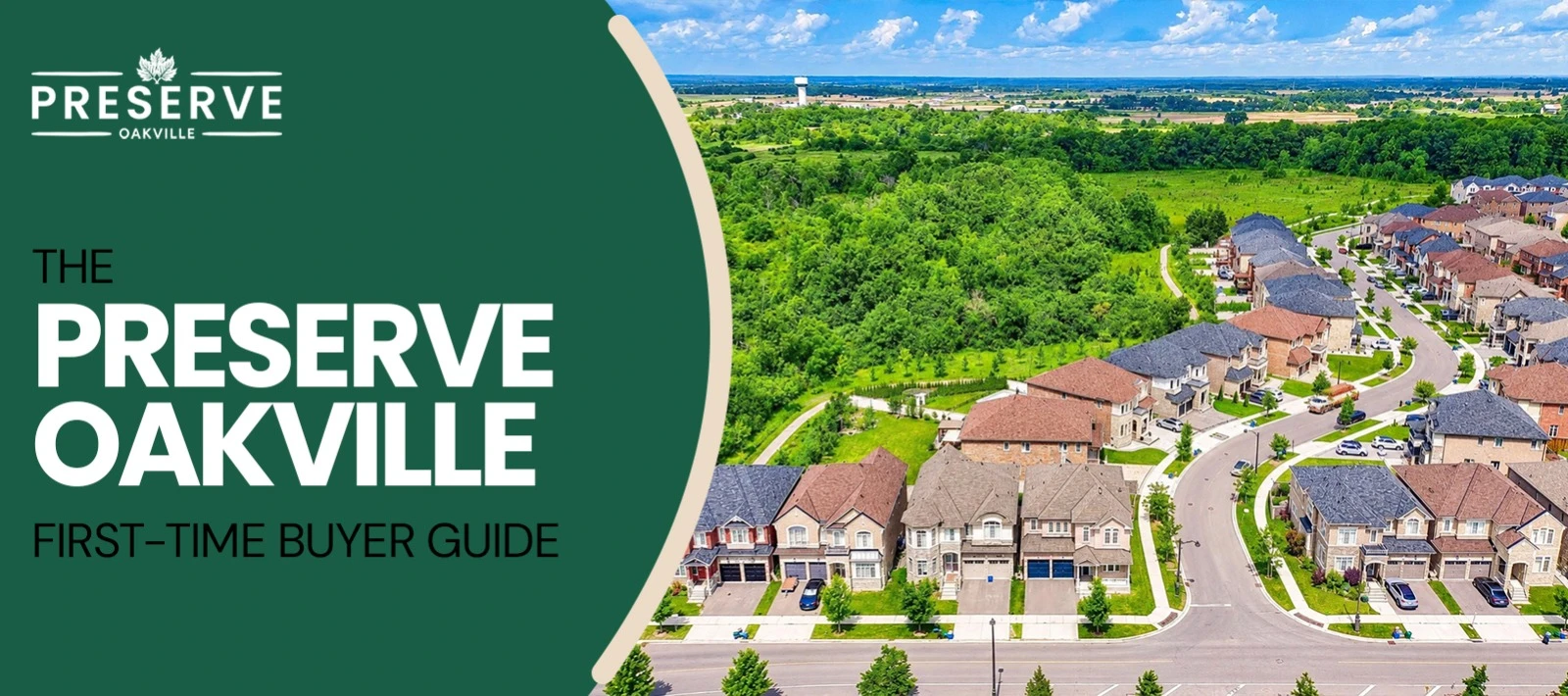
The Preserve is one of the more popular places in Oakville for first-time buyers, and the reason is the mix of homes. In many parts of town, a first purchase means competing for a detached house at a price far out of reach. Here, the same community includes condos, stacked townhomes, rear-lane townhomes, and detached homes, so there's a way in at more than one budget.
That variety also brings questions that older neighbourhoods don't raise, such as what a POTL fee is, why some streets have strict parking rules, and whether a home that's only a few years old needs an inspection. This guide answers those questions and walks through the money side, the buying steps, and daily life in The Preserve.
A quick note on numbers. Government programs, tax rules, fees, and local bylaws change over time. Where a figure appears below, it's the rule or typical amount at the time of writing, so confirm it with your lawyer, broker, or the Town of Oakville before you rely on it. Market prices are left out on purpose, since they move every month. Your agent can pull current sold prices for the exact home type you want.
What Is The Preserve in Oakville?
Before comparing homes, it helps to know what the community is and how it came together.
The Preserve Defined
The Preserve is a master-planned residential community in North Oakville, within the Glenorchy area. It was designed around walkable streets, parks, trails, and stormwater ponds, and it includes condos, townhomes, and detached homes built mostly in the last 15 years or so.
Where It Is and How It Was Planned
The community sits north of Dundas Street, close to Neyagawa Boulevard and Sixth Line, and it falls under the Town of Oakville's North Oakville planning framework. The layout uses narrower streets and a grid pattern to encourage walking, and the open space follows natural features such as Munn's Creek and a series of ponds and woodlots. Mattamy Homes built a large share of the community, though you may see other builders nearby.
Some newer sections toward the northern edge were still being built at the time of writing. If you're looking at a home near an active construction area, expect some noise and dust, and ask what's planned next door.
The Preserve Quick Facts
Topic | What to Know |
|---|---|
Area | North Oakville, part of Glenorchy |
Home types | Condo apartments, stacked and rear-lane townhomes, freehold and POTL townhomes, semi-detached and detached homes |
Age of homes | Mostly built since the early 2010s |
Main roads | Dundas Street, Neyagawa Boulevard, Sixth Line, Trafalgar Road |
Highways | Highway 407 and the Highway 403 and QEW corridor are close |
Schools | Halton District School Board and Halton Catholic District School Board, plus French boards |
Parks and recreation | Neighbourhood parks, trails, ponds, and the Sixteen Mile Sports Complex nearby |
Shopping | Plazas along Dundas Street and the Uptown Core |
Types of Homes in The Preserve Oakville: Condos, Townhomes, and Detached
The community has more than one kind of home, and each comes with its own costs and trade-offs.
Home Types Compared
Home Type | What It Is | Things to Check |
|---|---|---|
Condo apartment | A unit in a low-rise or mid-rise building | Monthly condo fee, status certificate, parking and locker, pet rules |
Stacked townhome | Townhome-style units with another unit above or below | Condo or common element fees, noise between units, parking |
Rear-lane townhome | Townhome with a garage off a back lane | Lane maintenance fee, parking, who owns the lane |
Freehold townhome | Townhome on its own lot, often with shared walls | Boundary lines, shared fences and rooflines, any monthly fee |
Semi-detached or detached | A house on its own lot, usually on a narrower lot than older suburbs | Lot backing onto a park or pond, grading, driveway length |
Condo, Freehold, and POTL: What's the Difference?
A condo owner owns the unit and shares ownership of the building through the condo corporation. A freehold owner owns the house and the land under it. A POTL townhome sits in between: you own the house and lot outright, but your lot is tied to a shared parcel, such as a private lane, visitor parking, or a green space, and you pay a monthly fee toward its upkeep.
This matters for budgeting and for lenders, because the monthly fee is a cost on top of your mortgage, property tax, and heating.
Preserve Oakville Condos and Townhomes: Which Suits a First-Time Buyer?
Condos and stacked townhomes tend to be the most accessible way into The Preserve, since they usually cost less than townhomes with their own lot. They suit buyers who want low maintenance, though the monthly fee takes a bite out of the budget.
Townhomes, especially rear-lane and freehold, sit in the middle. They give more space and a private entrance, and many first-time buyers with kids or plans for a family choose them. Detached and semi-detached homes sit at the higher end of the community's price range, and they're more common as a second or third purchase than a first one.
None of these is better in every case. A buyer who travels often might prefer a condo. A buyer who works from home and wants a bedroom for an office may stretch for a townhome.
Understanding POTL and Common Element Fees
Many townhomes in The Preserve come with a monthly fee that surprises first-time buyers, so it's worth understanding before you make an offer.
What Is a POTL?
A POTL, or Parcel of Tied Land, is a townhome lot that's legally tied to a shared common element, such as a private road, walkway, or visitor parking. The owner holds the house and lot in freehold, and also pays a monthly fee to a common elements condominium that maintains the shared parts.
What the Fee Covers
The fee usually pays for the upkeep of items you can't maintain individually, such as snow clearing on private lanes, repairs to shared pavement, landscaping, and a contribution to a reserve fund for larger repairs. The amount varies from block to block, so ask for the actual figure on the home you're considering.
Questions to Ask Before You Buy a POTL Townhome
What's the current monthly fee, and how often has it gone up?
What does it cover, and what's left for you to pay for separately?
How healthy is the reserve fund, and when was the last reserve fund study?
Is there any planned special assessment or major repair?
Are there rules about parking, pets, or exterior changes?
Your lawyer will review the status certificate for the common elements corporation. Make your offer conditional on that review, the same way you would for a condo.
Lenders typically count some or all of a monthly common element or condo fee when they calculate your debt ratios, which can lower the mortgage you qualify for. Mention it to your broker early so the pre-approval reflects it.
Down Payment, Mortgage, and First-Time Buyer Programs
The price of the home sets how much you need to put down, and a few programs can help you get there.
Minimum Down Payment Rules
Canada uses a tiered system. At the time of writing, the minimum is 5% on the first $500,000 of the price, 10% on the part between $500,000 and $1.5 million, and 20% on homes of $1.5 million or more. A down payment under 20% requires mortgage default insurance, and homes priced at $1.5 million or more can't be insured.
Purchase Price | Minimum Down Payment | Mortgage Insurance |
|---|---|---|
$550,000 | $30,000 | Required |
$900,000 | $65,000 | Required |
$1,200,000 | $95,000 | Required |
$1,500,000 | $300,000 | Not available |
These thresholds have changed in the past, so check the current figures with your lender.
Get Pre-Approved First
A mortgage pre-approval tells you what you can borrow and holds a rate for a set period. In The Preserve, where condo fees and POTL fees can affect your debt ratios, it also shows you how those costs change your range. For the documents and steps involved, see how mortgage pre-approval in Oakville works.
First-Time Buyer Programs
At the time of writing, these programs can help with the down payment and the closing bill:
First Home Savings Account (FHSA): Contributions are tax-deductible and withdrawals for a qualifying first home are tax-free, within annual and lifetime limits.
Home Buyers' Plan (HBP): You can withdraw from your RRSP for a first home, and you repay it to your RRSP over a set number of years.
Ontario land transfer tax rebate: Eligible first-time buyers can get a rebate of up to $4,000 on the provincial tax.
Federal Home Buyers' Amount: A non-refundable tax credit you can claim on your tax return in the year you buy.
The FHSA and the HBP can generally be used together. RRSP money meant for the HBP usually has to sit for a minimum period before you withdraw it, while the FHSA has no such holding rule. Limits and rules change, so check the Canada Revenue Agency website for the current figures.
Closing Costs and Carrying Costs
The purchase price is only part of what you'll pay. Closing costs come first, and the monthly costs of owning the home follow.
Land Transfer Tax Example
Oakville doesn't charge a municipal land transfer tax, so buyers pay only the provincial one. For a home priced between $400,000 and $2 million, you can calculate it as $4,475 plus 2% of the amount over $400,000.
On a $900,000 townhome, that's $4,475 plus $10,000, which comes to $14,475. A first-time buyer who qualifies for the rebate pays about $10,475 after the $4,000 credit.
Other Closing Costs
Add the legal fee and disbursements, title insurance, adjustments for prepaid property tax and utilities, and the home inspection. If you put down less than 20%, there's also an 8% provincial sales tax on the mortgage insurance premium, which is paid in cash at closing. Many buyers budget about 2% to 4% of the purchase price in total. For a breakdown of each item, see property transfer and closing costs in Oakville.
Property Tax, Utilities, and Insurance
Property tax in Oakville is a percentage of your home's assessed value, and the bill combines the Town, Halton Region, and education portions. The rate changes each year, so ask your agent for the current rate and the last tax bill on the home. There's also a separate stormwater charge in Oakville, billed apart from property tax.
One point that catches newer-home buyers off guard: if a home was recently built or finished, the provincial assessment agency (MPAC) may not have fully assessed it yet. A supplementary tax bill can arrive later and cover a past period. Ask your lawyer and the seller how the home's assessment stands, and keep some cash aside in case.
Newer homes tend to have lower heating costs than older ones because of modern insulation and windows, but gas, hydro, water, and home insurance still add up. Get quotes before you finalize your monthly budget.
The Buying Process, Step by Step
Get pre-approved. Know your range and your rate hold before you look.
Choose an agent and a lawyer. Pick people who know North Oakville and POTL and condo purchases.
Tour homes with a checklist. Look at parking, the lot, the street, and what's next door.
Make an offer. Your agent writes the Agreement of Purchase and Sale.
Pay the deposit. It's usually due within a day or so of acceptance.
Complete your conditions. Typically financing and inspection, plus a status certificate review for condos and POTL townhomes.
Lawyer's work. Title search, tax and utility adjustments, and registration.
Closing day. Funds transfer, the title registers, and you get the keys.
Offers, Deposits, and Conditions
The deposit is often around 5% of the price, but it depends on the agreement, so ask your agent what the seller expects. It's held in trust and counts toward your down payment.
First-time buyers should be cautious about dropping conditions. A financing condition and an inspection condition protect you if the lender doesn't approve the mortgage or if the home has a serious problem. In a quick market, your agent can help you decide which conditions to keep and how to shorten the timelines.
The time from offer to closing depends on what you and the seller agree to. Many closings land somewhere between a month and three months out, and a vacant home or a quick-possession sale can be faster.
Inspecting a Newer Home
A home that's only a few years old can still have problems, and many are small items that are cheap to fix if you catch them early. Ask your inspector to look closely at:
Attic insulation and ventilation, including bathroom fans that vent properly
Grading and drainage around the foundation, since new subdivisions settle
Roof valleys and flashing on the complex rooflines common on townhomes
Basement walls and floors for settlement cracks or moisture
Party walls, shared rooflines, and brick or flashing repairs on townhomes, since who pays for what can depend on the lot lines and any shared agreements
Windows, doors, and caulking, which often need adjustments in the first years
Some newer homes may still be covered by the builder's warranty through Tarion. Ask the seller when the home was enrolled and if any claims are still open.
Condo and POTL Status Certificates
For a condo or POTL townhome, your lawyer reviews the status certificate. It shows the fees, the reserve fund, insurance, rules, and any lawsuits. This is how you find out about a low reserve fund or a planned special assessment while you can still walk away.
Resale or New Construction in The Preserve?
Some parts of the community are fully built and sold as resale homes. Others, toward the edges, may still have new builds from the builder. They work differently.
With a resale home, you secure a pre-approval, make an offer, and close within a few weeks or months with your rate held. With a new build, closing can be a year or more after you sign, and you'll qualify under the rules and rates in place at final closing. New builds also come with HST questions, development charge adjustments, and builder deposits paid in stages, so read the agreement closely and have your lawyer review it during any cooling-off period.
If you want a home you can move into soon, resale tends to be simpler. If you want a specific layout and can wait, a new build may suit you better.
Daily Life in The Preserve
A few everyday details, from parking to schools to the commute, can change how well a home fits your routine.
Parking and Street Rules
The streets are narrower than in older suburbs, and many homes have a single garage plus a short driveway. The Town of Oakville has rules for on-street and overnight parking, and it offers overnight parking permits in some areas for visitors or short-term needs. What applies depends on the street, so check the Town's website for the rules, permit options, and fees that apply to the address you're considering, and count how many vehicles your household will have. If you need space for two cars, check that the home's garage and driveway fit them, and don't count on street parking.
Schools
The Preserve is served by the Halton District School Board and the Halton Catholic District School Board, and French programs are available through the French boards. At the time of writing, local elementary schools include Oodenawi Public School and St. Gregory the Great Catholic Elementary School.
School boundaries are set by address and can change when boards review them. Never rely on a listing to confirm a school zone. Use the school locator tools on the Halton District School Board and Halton Catholic District School Board websites and enter the exact address.
Commute and Transit
The community is close to Highway 407, and the Highway 403 and QEW corridor is a short drive south. Oakville GO Station is a drive away rather than a walk, so many commuters drive or take a local bus to the station and then ride the train. Local bus routes connect the area to the Uptown Core and the GO station, and routes and schedules change, so check Oakville Transit for the current map.
Drive times to Mississauga, Burlington, and Toronto vary a lot by time of day, so test your own commute at rush hour before you buy.
Parks, Trails, and Recreation
Parks are part of the plan. Isaac Park and George Savage Park are two of the neighbourhood parks, and paved trails run along the ponds and Munn's Creek. The Sixteen Mile Sports Complex nearby has arenas, pools, and a library branch. The Glenorchy Conservation Area is nearby, which helps keep nature close.
Garbage and Recycling
Halton Region handles curbside garbage and green cart collection. Blue box recycling in Ontario now runs through a producer-led system overseen by Circular Materials Ontario, so check the Halton Region website for your collection schedule and what goes in each bin.
Shopping and Healthcare
Plazas along Dundas Street, the Uptown Core, and nearby grocery stores handle most errands, though you'll want a car for big shopping trips. Oakville Trafalgar Memorial Hospital is a short drive away along Dundas Street West.
Common Mistakes First-Time Buyers Make in The Preserve
Looking only at the mortgage payment and forgetting condo or POTL fees, property tax, and insurance
Assuming a newer home doesn't need an inspection
Not checking parking: the garage size, driveway length, and street rules
Relying on a listing for the school zone instead of checking the board's locator
Skipping the status certificate review on a condo or POTL townhome
Forgetting that closing costs are paid in cash, on top of the down payment
Not asking about a supplementary property tax bill on a recently built home
Comparing prices without matching the home type, such as a freehold townhome against a POTL one
Is The Preserve Right for You?
What Works Well | What to Weigh |
|---|---|
A range of home types, from condos to detached homes | Prices are high for Oakville's northern area, and a condo or townhome may be the realistic entry point |
Newer homes with modern layouts and systems | Some blocks have monthly fees that add to your costs |
Parks, trails, and the sports complex nearby | Narrow streets and parking rules need planning |
Quick access to Highway 407 | Daily errands and the GO station usually need a car |
Schools within the community | Boundaries can change, so verify by address |
The Preserve tends to suit first-time buyers who want a newer home, families who want parks and schools nearby, and newcomers to Canada who want an established community with a lot of other recent buyers. It's less suited to someone who wants a large lot, mature trees, or a short walk to a train station.
Final Thoughts
The Preserve gives first-time buyers more ways in than most parts of Oakville, but the cost of entry is more than the list price. The monthly fees, the parking rules, the closing costs, and the school boundary check all deserve a place in your plan before you make an offer.
Start with a pre-approval, then decide which home type fits your budget and your daily routine. Visit at different times of day, look closely at the block and the lot, and ask for the real numbers on fees and taxes. If you'd like help with current listings and recent sales in The Preserve, talk with an agent who knows the community well.
FAQs
Is The Preserve a good area for first-time home buyers?
Yes, for many buyers. The community offers condos, townhomes, and detached homes, so there's more than one price point. The homes are newer, parks and schools are close, and the commute routes are good. Your budget and your parking needs will decide which type works best.
What types of homes are available in The Preserve?
You'll find condo apartments, stacked townhomes, rear-lane townhomes, freehold and POTL townhomes, and semi-detached and detached homes. Most were built in the last 15 years or so, and some newer sections near the northern edge may still be under construction.
What is a POTL townhome?
A POTL townhome is a freehold home on a lot that's tied to a shared parcel, such as a private lane or visitor parking. You own the house and lot, and you pay a monthly fee toward maintaining the shared parts.
How much down payment do I need for a home in The Preserve?
It depends on the price. At the time of writing, the minimum is 5% on the first $500,000, 10% on the part up to $1.5 million, and 20% for homes at $1.5 million or more. For example, a $900,000 home needs at least $65,000 down.
Does Oakville have a municipal land transfer tax?
No. Oakville and the rest of Halton Region don't charge a municipal land transfer tax. Buyers pay the Ontario provincial land transfer tax only, and eligible first-time buyers can claim a rebate of up to $4,000.
What are the parking rules in The Preserve?
The Town of Oakville has on-street and overnight parking rules, and the streets are narrow. Check the Town's current rules and permit options before you buy, and confirm that the home's garage and driveway fit your vehicles.
How do school boundaries work in The Preserve?
Schools are assigned by address, and boundaries can change when boards review them. Use the school locator tools from the Halton District School Board and the Halton Catholic District School Board, and enter the exact address before you make an offer.
Is it better to buy a resale home or a new build in The Preserve?
It depends on your timeline. A resale home usually closes within weeks or months, and you know what you're getting. A new build can take a year or more to close, comes with extra charges, and lets you pick a layout. Have your lawyer review a new build agreement before you sign.
Is The Preserve a buyer's market or a seller's market?
It changes over time, and it also varies by home type. Condos, townhomes, and detached homes can move at different speeds. Ask your agent for recent sold prices and days on market for the exact type of home you want, and use those to guide your offer.
How far is The Preserve from the GO station and highways?
Highway 407 is close, and the Highway 403 and QEW corridor is a short drive south. Oakville GO Station is a drive or a bus ride away, not a walk. Test your own commute at rush hour before you buy.
Recent Blogs

Elementary Schools in The Preserve Oakville & Homes Nearby
October 13, 2026
Read More
Living in The Preserve Oakville: Commute, GO & Home Values
October 12, 2026
Read More
Pre-Construction vs. Resale Homes in The Preserve
October 9, 2026
Read More
Property Transfer & Closing Costs in Oakville: Buyers Guide
October 7, 2026
Read More